
When your AC quits on a hot afternoon in Grandville, it rarely happens at a convenient time. Usually the house starts feeling heavy, the thermostat keeps climbing, and everyone notices at once. If you're in Grandville, Jenison, Hudsonville, or nearby, the first question usually isn't technical. It's practical. Can this be fixed quickly, what will the visit look like, and is this unit even worth repairing anymore?
That decision gets easier when you know what you're listening for, what a technician should check, and how to judge the difference between a smart repair and throwing money at an aging system. If you're trying to sort through AC repair near Grandville MI, it helps to look past generic service lists and focus on what matters in a real home: diagnosis, cost, timing, and trust.
Table of Contents
- Your Guide to Fast AC Repair in Grandville
- Common AC Problems and What They Mean
- What to Expect During Your AC Service Visit
- Understanding AC Repair Costs in Grandville MI
- Should You Repair or Replace Your Air Conditioner
- Why West Michigan Trusts Platinum Heating and Cooling
- Frequently Asked HVAC Questions
Your Guide to Fast AC Repair in Grandville
A lot of summer service calls start the same way. The system ran fine yesterday, then today it's blowing warm air, short cycling, or not turning on at all. In West Michigan, that can turn into an urgent problem fast, especially in homes with upstairs bedrooms, older insulation, or people who don't tolerate heat well.
What helps most in that moment is a clear process. Start with the basics. Check the thermostat setting, make sure the filter isn't packed, and confirm the breaker hasn't tripped. If the system still isn't cooling, the next move is getting a real diagnosis, not guessing at parts.
For homeowners who want local scheduling options, this air conditioner service near you in West Michigan page is one practical place to start. On the operations side, a lot of HVAC companies also rely on systems for always-on business call handling, which matters more than people realize when breakdowns happen after hours and a missed call means a hot house all night.
When an AC fails in summer, speed matters, but accuracy matters more. A fast wrong repair still leaves you hot.
The good news is that most problems show warning signs before total failure. If you catch those early, you usually have more options and less stress.
Common AC Problems and What They Mean
A homeowner usually notices symptoms before they notice causes. That's normal. You hear a buzz, see ice, smell something musty, or realize the system never seems to shut off. Those clues matter because they help narrow the problem down before anyone starts replacing parts.
Symptoms that usually point somewhere specific
Here's a plain-English guide you can use when your system starts acting up.
| Symptom | Potential Cause | Recommended Action |
|---|---|---|
| Warm air from vents | Thermostat issue, airflow problem, electrical fault, or refrigerant-side problem | Check thermostat settings and filter, then schedule service if cooling doesn't return |
| Weak airflow | Dirty filter, blocked coil, blower problem, or duct restriction | Replace filter, open closed vents, and have airflow checked |
| System runs constantly | Dirty coil, airflow issue, low cooling capacity, or control problem | Turn the thermostat to a realistic setting and have the unit inspected |
| Rattling or vibrating noise | Loose panel, hardware, fan issue, or debris in outdoor unit | Shut it down if the noise is severe and request service |
| Buzzing or humming | Electrical component issue or struggling motor | Avoid repeated resets and have a technician test components |
| Musty smell | Moisture buildup, dirty coil, or drainage issue | Replace filter and schedule cleaning or service if the smell remains |
| Ice on the system | Low airflow or refrigerant-related issue | Turn the unit off and don't keep forcing it to run |
| Water around indoor unit | Drain blockage or condensate problem | Shut it off if water is spreading and have the drain system checked |
What homeowners can safely check first
A few checks are worth doing before you call:
- Thermostat setting: Make sure it's set to cool and the target temperature is below room temperature.
- Air filter condition: A clogged filter can choke airflow and create bigger problems than anticipated.
- Supply vents: Closed or blocked vents reduce system airflow and can make rooms feel uneven.
- Outdoor unit condition: Clear away visible debris, but don't start taking panels apart.
If your issue involves dirty condenser fins or surface buildup outside, use a gentle approach. This overview of a safe AC coil cleaning technique is useful for understanding what careful cleaning looks like and what can bend or damage the coil.
For cooling complaints that don't have an obvious cause, this air conditioner not cooling troubleshooting guide can help you narrow down what you're seeing before the service call.
Ice isn't a sign that the AC is working extra hard. It's a sign something is wrong.
The main thing not to do is keep resetting the system and hoping it clears up. That often turns a manageable problem into a bigger one.
What to Expect During Your AC Service Visit
You call for AC repair on a hot Grandville afternoon, and the main question is usually simple. Is this going to be a straightforward fix, or are you about to hear that the system is near the end?
A good service visit should answer that without guesswork.
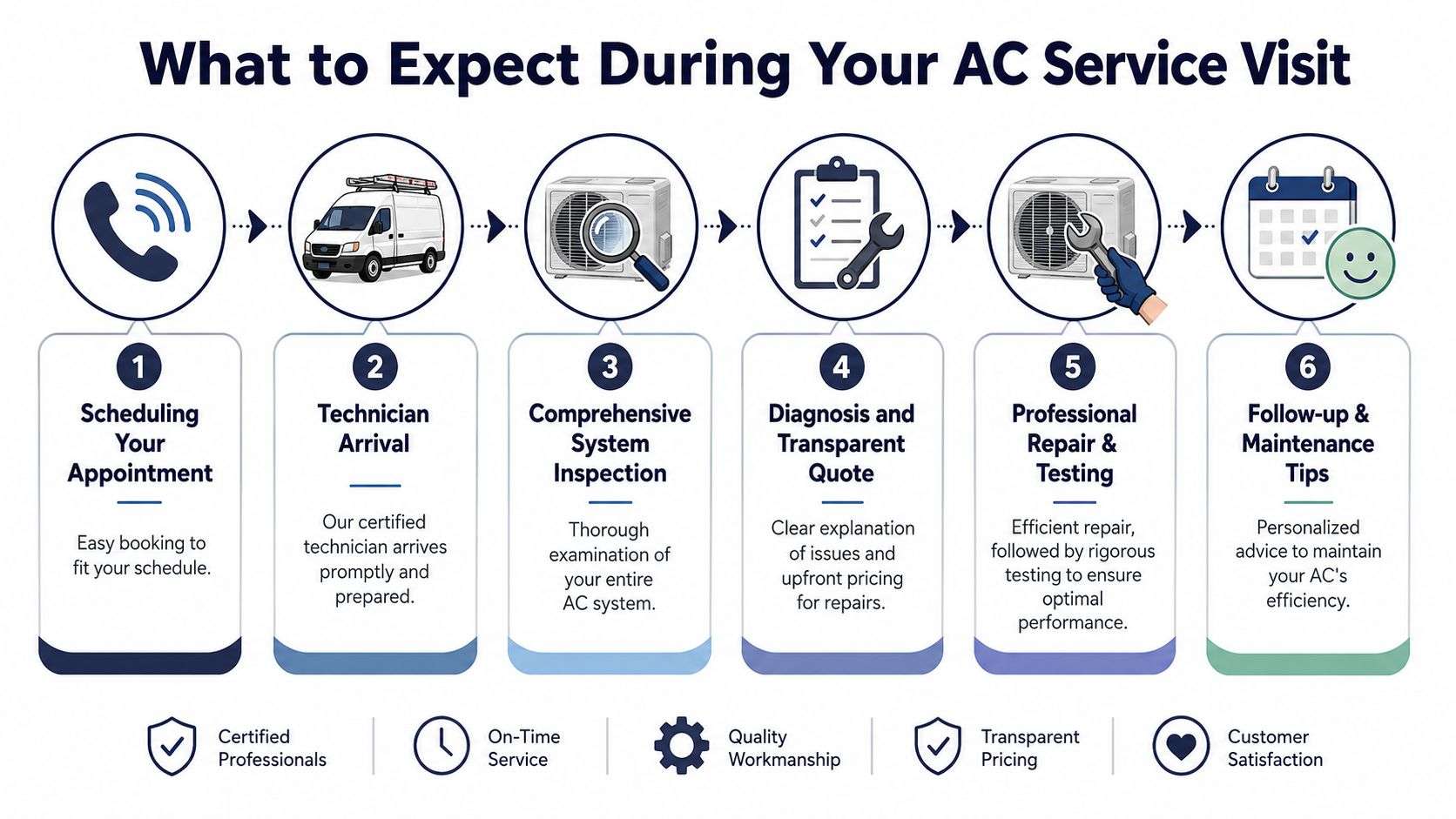
How the appointment usually starts
Before any tools come out, a technician should ask a few pointed questions about what the system has been doing. Does it run but not cool well? Does it trip a breaker, freeze up, or shut off too early? Has the problem been constant, or only during hotter afternoons?
Those details shape the diagnostic path. A unit that runs constantly points in a different direction than one that will not start at all.
Once the technician is on site, expect a full look at the system, not just the outdoor unit. That usually means checking thermostat operation, filter condition, indoor airflow, electrical components, drain function, and how the condenser starts and runs. In West Michigan, where systems can sit through long heating seasons and then get pushed hard when summer hits, it is common to find more than one issue at the same visit.
What a real diagnosis includes
The best service calls follow a process. The technician observes the system, tests the controls, checks electrical readings, and confirms whether the equipment is moving heat the way it should. If refrigerant charge is in question, it should be measured properly, not guessed at from pressure alone.
That matters because low airflow, a dirty coil, a restriction, and refrigerant problems can create similar symptoms. Homeowners often hear "it just needs refrigerant," but a careful technician will first confirm why performance dropped in the first place. Otherwise, the cooling may improve for a short time and then fail again.
This is also the point where you learn whether the problem is isolated or part of a bigger pattern. A failed capacitor on an otherwise healthy system is one conversation. Repeated repairs, weak cooling, aging components, and signs of strain are a different one.
What you should hear before approving repair
Before any work starts, you should get a clear explanation in plain language. That should cover:
- What was found: The failed part, airflow problem, electrical fault, drainage issue, or refrigerant-related concern.
- What needs to be done now: The repair required to restore cooling safely and correctly.
- What can wait, if anything: Items that are worn or worth watching but are not the reason the system stopped working today.
- What the repair is likely to accomplish: Whether it should solve the problem fully or whether the system still has age-related risk.
Vetting the company proves its worth in real-life situations. A solid technician explains the findings, answers questions directly, and gives you room to decide. If the recommendation jumps straight to a major replacement without a clear diagnostic reason, ask what test results or equipment condition led them there.
A trustworthy service visit leaves you with a diagnosis, a recommendation, and a clear reason for both.
What happens after the repair
The final step should be operational testing under normal cooling conditions. The system should run long enough to confirm that temperatures, airflow, and overall operation make sense. It should not be treated like a quick parts swap with no verification.
You should also know what to watch for after the visit. Sometimes the answer is simple. Cooling should return and stay steady. Sometimes the honest answer is more nuanced. The repair may get you through the season, but the technician may also explain that the unit is becoming expensive to keep alive.
That kind of visit helps you make the next decision with your eyes open, which is what good AC service is supposed to do.
Understanding AC Repair Costs in Grandville MI
A lot of Grandville homeowners ask the same question after the diagnosis: Is this a manageable repair, or is this the kind of bill that means the system is on borrowed time?
The honest answer depends on what failed, how long it takes to confirm the problem, and how much life the equipment likely has left after the repair. Some service calls end with a straightforward fix. Others uncover a larger issue that forces a real repair-versus-replace decision.
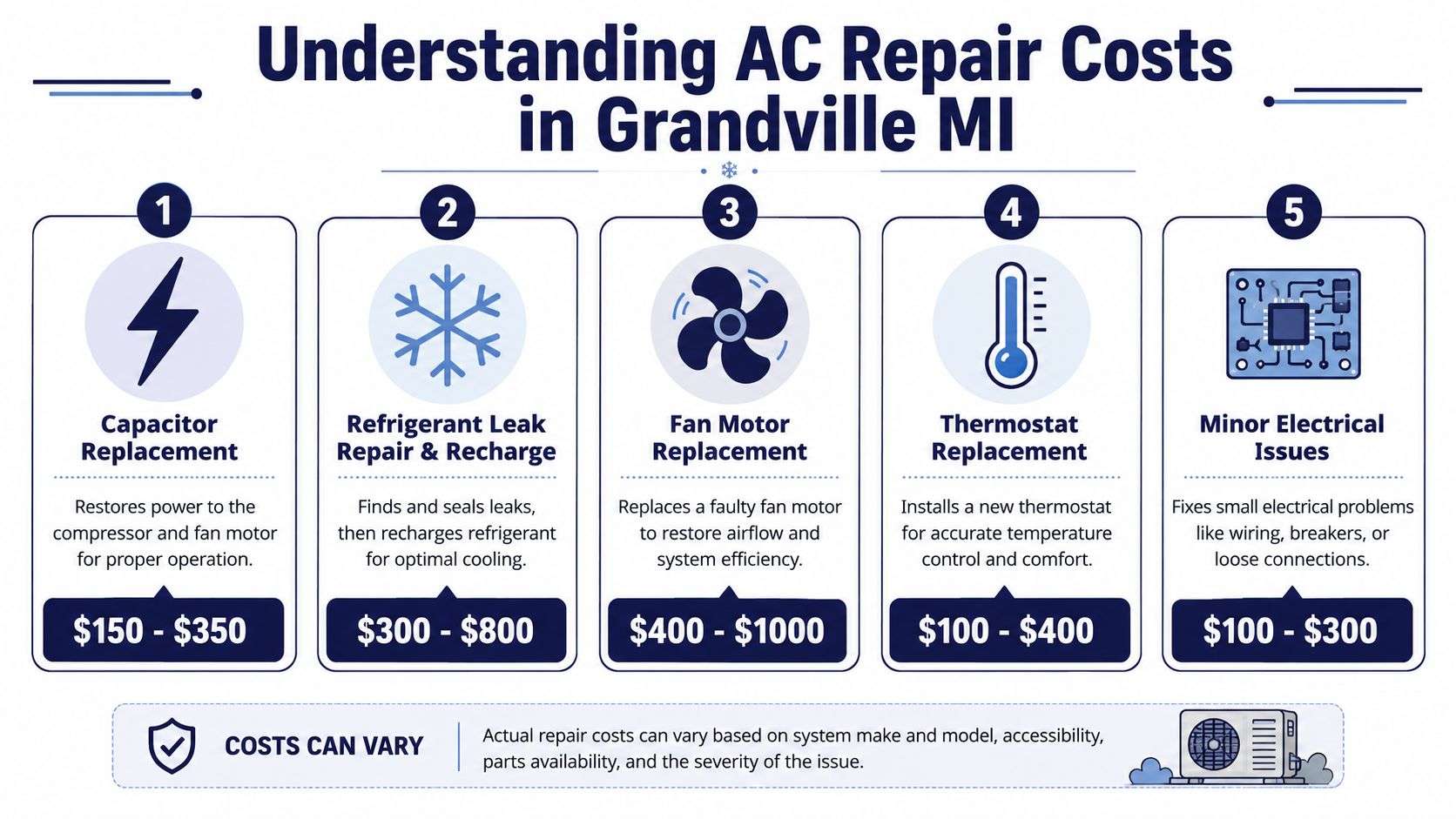
In practical terms, lower-cost repairs usually involve electrical components, controls, capacitors, contactors, drain issues, or a simple service correction. Costs climb when the problem involves a motor, refrigerant leak testing and repair, a coil issue, or a compressor-related failure. Labor matters too. An intermittent problem that only shows up under load can take more time than a part that has clearly failed.
What changes the final invoice
A repair bill usually moves based on a few real-world factors:
- The failed part: Small control components cost less than major mechanical parts.
- Time spent diagnosing: Intermittent faults and multi-issue systems take longer to pin down.
- System access: Tight attic, crawlspace, or side-yard installations add labor.
- Overall equipment condition: Dirty coils, neglected maintenance, and worn wiring often turn one repair into several.
- Timing: Emergency or after-hours calls usually cost more than a scheduled weekday visit.
One of the biggest cost mistakes homeowners make is judging the repair by the part alone. A capacitor may be inexpensive, but the visit still includes diagnostic time, testing, and verification that nothing else caused the failure. On the other hand, an expensive quote is not automatically a bad quote if the technician can show the failed component, explain the testing, and tell you what result to expect after the work is done.
What transparency should look like
A good estimate should answer three questions clearly: what failed, what it takes to fix it, and whether the repair makes sense for the age and condition of the unit. If any of that is fuzzy, ask for a plain-language explanation.
For homeowners trying to weigh the bigger decision, our guide on when to replace an air conditioner can help frame the numbers in context. A repair that is reasonable on a 9-year-old system may not be the smart move on a unit that is near the end of its service life.
West Michigan weather adds another layer. During a July heat wave, speed matters. During the shoulder seasons, some homeowners choose to repair now and plan replacement on their schedule instead of rushing into it during the hottest week of the year. That is often the better financial decision if the system can be kept running safely in the meantime.
Should You Repair or Replace Your Air Conditioner
You hear the system kick on, but the house still feels muggy by late afternoon. The unit can probably be fixed. The better question is whether putting more money into it is the smart call for your home, your budget, and the rest of the cooling season.
Age matters, but age alone does not make the decision. In the trade, central air systems often start giving homeowners harder repair-versus-replace choices as they get older, especially if maintenance has been inconsistent or efficiency has slipped over time. I tell Grandville-area homeowners to look at the full pattern. How well has the system cooled over the last few summers? Has it needed repeat service? Is this a small part failure, or the kind of repair that shows the equipment is wearing out as a whole?
If the unit has been dependable and this is a one-off problem, repair is usually the practical move.
If the system has turned into a regular expense, replacement deserves a closer look.
Signs repair still makes sense
Repair is often the right choice when:
- The problem is limited: One failed part or one clear issue, without signs that other components are failing too.
- The system was keeping up before the breakdown: Temperatures were consistent, humidity felt under control, and runtime seemed normal.
- The unit still has useful life left: You are not trying to squeeze several more summers out of equipment that has already become unreliable.
- The repair cost is reasonable for the condition of the system: Spending some money on a solid mid-life unit is very different from spending the same amount on a worn-out one.
Signs replacement deserves a serious look
Replacement starts to make more sense when the repair fixes today's problem but not the bigger pattern.
- Breakdowns keep happening: Different parts fail every season, or the same issue keeps coming back.
- Comfort has dropped off: Certain rooms stay warm, the house feels sticky, or the AC runs longer without delivering the same result.
- A major component has failed on an older unit: Compressor or coil repairs can be hard to justify if the rest of the system is already near the end of its run.
- You are planning around the AC instead of trusting it: That usually means the equipment is no longer giving you dependable service.
A useful rule in the field is simple. If you are paying for a repair and also wondering what will fail next, you are already close to replacement territory.
That does not mean every older system should be swapped out right away. Some homeowners in West Michigan choose a smaller repair now and schedule replacement on their terms, before the next hot stretch hits. Others are better off replacing now because they want better reliability, lower electric bills, or fewer surprise calls. If you want a clearer framework, this guide on when to replace an air conditioner helps break down the decision in plain language.
The best choice comes from the full picture. System age, repair history, comfort, energy use, and how long you plan to stay in the home all matter. A good service company should walk you through both options without pressure, show you why the repair failed, and tell you plainly whether the unit is worth another investment.
Why West Michigan Trusts Platinum Heating and Cooling
A lot of trust is built on what happens when the house is hot and the schedule is full. Grandville homeowners usually are not looking for a sales pitch in that moment. They want a company that shows up when promised, finds the actual problem, and explains whether the repair makes sense for the age and condition of the system.
That is why company vetting matters as much as the repair itself. In West Michigan, a good AC contractor should be ready to work on older homes, newer builds, rentals, light commercial spaces, and the mix of equipment common across Grandville, Jenison, Hudsonville, Wyoming, Walker, Standale, and Allendale.

What to check before you book service
A few questions tell you a lot, fast.
- Are the technicians EPA-certified and insured? That is basic protection for you and a sign the company takes the work seriously.
- Will they diagnose before quoting a major repair or replacement? Homeowners should hear what failed, why it failed, and what the next likely issues are if the unit is older.
- Do they handle more than emergency calls? A company that also does maintenance, inspections, and full system replacements can usually give better repair-versus-replace guidance.
- How do they communicate? Clear arrival windows, plain-language explanations, and approval before work starts matter more than polished marketing.
Why local coverage matters
Regional experience shows up in small details. Technicians working across West Michigan see the airflow problems that come with older floor plans, the drainage issues that show up in humid weather, and the wear that hits hard during long heating seasons followed by summer AC demand.
Platinum Heating and Cooling fits that service model. The company handles residential and commercial HVAC repair, replacement, maintenance, inspections, and 24/7 emergency service with EPA-certified, insured technicians. For a homeowner, that matters because the same company can often help with today's breakdown, next season's tune-up, and a future replacement if the system is near the end.
What makes an ongoing service relationship useful
Consistency provides value. If the same company has seen your equipment before, service calls tend to move faster and the recommendations are usually more grounded in the unit's actual history.
Maintenance plans can help with that by giving you:
- Seasonal system checks: Problems like weak airflow, dirty coils, or drain issues are easier to address before the first stretch of hot weather.
- Priority scheduling: Helpful during the busiest summer weeks, when waiting even an extra day can feel long.
- Support across the year: Cooling service in summer and heating support through the long West Michigan winter.
Community ties still matter, too. Discounts for veterans and first responders, along with steady service across the area, usually point to a company that expects to keep working with the same neighborhoods for years.
Frequently Asked HVAC Questions
How often should I service my HVAC system
For most homes, cooling equipment should be checked before the heavy summer season, and heating equipment should be checked before winter demand starts. In West Michigan, that means thinking about AC before the warm months and furnace performance from November through April.
What can I do before calling for AC repair
Start with the simple items that cause a surprising number of no-cool calls:
- Check the thermostat: Wrong mode or dead batteries can look like equipment failure.
- Replace a dirty filter: Restricted airflow creates comfort issues and can trigger icing.
- Clear vents and registers: Furniture, rugs, and closed vents reduce airflow where you need it most.
If the system is frozen, leaking heavily, or making harsh electrical or mechanical noises, shut it off and schedule service instead of forcing it to run.
What should I ask when choosing an HVAC company
Ask direct questions. Are the technicians certified and insured? Will they diagnose before quoting? Do they explain repair versus replacement when both are on the table? Do they work on both residential and commercial systems if you manage rental or mixed-use property?
Those questions usually tell you more than a generic promise ever will.
Is a maintenance membership worth it
For a lot of homeowners, yes, especially if the system is older or the house depends heavily on one central unit. Priority service, scheduled tune-ups, and routine inspections help catch small issues before they become inconvenient breakdowns.
How can I help my AC run better between visits
Keep filters changed on schedule, keep supply vents open, make sure the outdoor unit has room to breathe, and pay attention to new sounds or weaker airflow. Small changes are often the first warning that service is needed.
If your AC isn't keeping up, or you're trying to decide whether to repair or replace, Platinum Heating & Cooling is a local West Michigan option for inspections, repairs, replacement estimates, and emergency HVAC service.