
When the heat goes out in January or the cooling drops off during a packed summer workday, most businesses in Jenison don't need a lecture on HVAC. They need the building stable again, fast. Employees get distracted, tenants start calling, customers notice right away, and managers suddenly have to stop what they're doing to deal with a mechanical problem that was easy to ignore the week before.
That's the nature of commercial HVAC service in Jenison MI. It isn't just about equipment. It's about keeping offices open, retail spaces comfortable, production areas usable, and multi-tenant properties predictable to manage across West Michigan, including Hudsonville, Jenison, Grandville, Walker, Standale, Allendale, and Wyoming, Michigan.
Table of Contents
- Your Partner for Business Comfort in Jenison MI
- Core Commercial HVAC Services for Every Season
- Expertise in Rooftop Units and Multi-Unit Systems
- The Value of Proactive HVAC Maintenance
- How to Choose a Commercial HVAC Contractor in Jenison
- Key Factors That Influence Service Pricing
- Frequently Asked Questions About Commercial HVAC
Your Partner for Business Comfort in Jenison MI
A Jenison storefront that opens at 8 a.m. cannot wait until noon for heat to come back. A medical office with poor ventilation starts hearing about stale air before the thermostat ever shows a problem. In this market, commercial HVAC affects revenue, tenant retention, staff comfort, and day-to-day credibility.
Local businesses deal with real seasonal pressure. From November through April, reliable heat protects pipes, equipment, employees, and customer traffic during long stretches of cold weather. In summer, the calls change. Humidity rises, back offices run warm, rooftop equipment strains in the afternoon, and uneven cooling makes parts of the building hard to use.
Indoor air quality gets missed too often. In commercial spaces, comfort complaints are not always caused by temperature alone. Outside air balance, filtration, airflow, and exhaust all affect how a building feels and how well it operates, especially in offices, retail spaces, churches, mixed-use properties, and light industrial buildings around Jenison and the greater West Michigan area.
The practical question for an owner or property manager is simple. Where will an HVAC failure hurt the business first?
Practical rule: In commercial buildings, the most expensive HVAC problem is usually the disruption that follows, not the failed part itself.
A small refrigerant leak can turn into complaints from several suites. A control issue can leave one area overheating while another stays cold. A ventilation problem can keep getting treated like an AC problem if nobody checks how the building is moving air.
A sound commercial HVAC plan starts with three priorities:
- Accurate diagnosis: The first visit should sort out whether the problem is equipment, controls, airflow, ventilation, or building load.
- Seasonal timing: Heating work needs attention before winter service demand tightens up. Cooling and humidity issues are cheaper to address before summer exposes them.
- Business-first decisions: Repair and replacement choices should fit occupancy, operating hours, tenant needs, and risk tolerance, not just the unit nameplate.
That is what reliable commercial service looks like in Jenison. Keep the building usable, keep complaints down, and avoid the kind of downtime that costs more than the repair.
Core Commercial HVAC Services for Every Season
A Jenison business can feel fine on a mild Tuesday and become a problem building by the first hard weather swing. A retail store starts losing customer comfort when the front doors keep opening in January. An office with west-facing glass fights hot spots in July. A church or mixed-use property may deal with both, plus stale air during peak occupancy. Commercial HVAC service has to match those operating conditions, not just the equipment label.
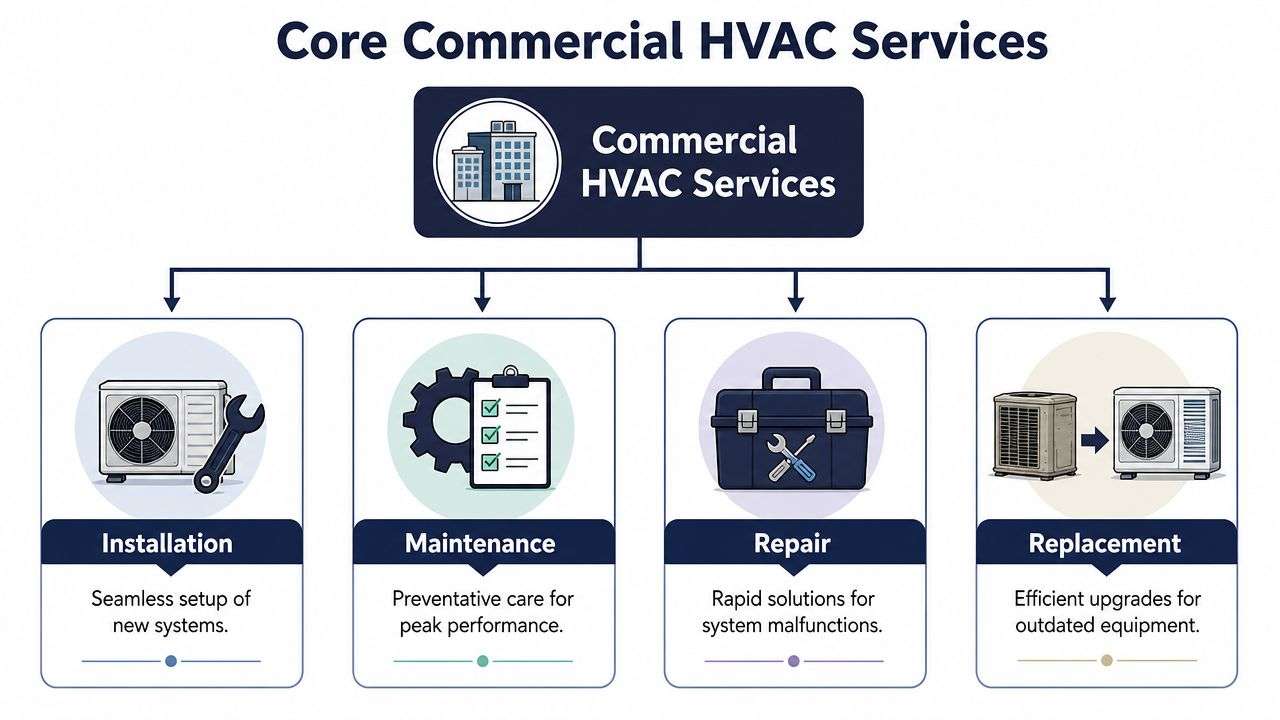
Installation that fits the building
Good installation starts with how the space is used hour by hour. Customer traffic, shipping doors, kitchen heat, computer loads, ceiling height, and occupancy swings all change how a commercial system should be sized and controlled. A quiet professional office in Jenison does not need the same approach as a storefront on a busy corridor or a light industrial building with process heat.
In West Michigan, the seasonal priority changes fast. From November through April, businesses usually focus on heating reliability, make-up air, boiler performance, and perimeter comfort. Once warmer weather arrives, the conversation shifts to cooling capacity, humidity control, and whether the building can stay comfortable during long afternoon load periods.
Design errors get expensive. Oversized equipment tends to short cycle, miss humidity targets, and create uneven temperatures between zones. Undersized equipment runs too long, struggles on peak days, and wears out faster. On buildings with packaged systems, split systems, or larger commercial rooftop HVAC units, the right layout and control strategy usually matter as much as the tonnage.
Repairs that solve the root cause
Commercial repair work should restore operation and explain why the problem happened. If a unit trips on safety, the answer may be a failed component, but it may also be airflow, dirty coils, sensor drift, building pressure, a stuck economizer, or a control sequence issue. Replacing parts without checking system conditions is how repeat calls happen.
That matters even more in multi-tenant and mixed-use buildings. One complaint can come from a bad actuator, poor balancing, a ventilation setting, or a schedule conflict in the controls. In summer, a clammy office may point to short cycling or poor latent removal. In winter, cold complaints near exterior walls may have more to do with airflow and perimeter loss than a furnace that has stopped heating.
A repair is complete when the occupied space holds temperature, airflow, and ventilation the way the business needs it to.
Indoor air quality belongs in the repair conversation too. If employees report odors, stuffiness, or inconsistent airflow, the issue may sit in filtration, outside-air settings, exhaust balance, or dirty internal components. Those problems affect comfort, but they also affect productivity and how customers experience the space.
Seasonal maintenance that protects uptime
Most commercial breakdowns give warnings first. Belts wear, drains start to back up, igniters weaken, filters load up, economizers drift out of calibration, and sensors stop reading accurately. Seasonal maintenance catches those issues before they interrupt business hours or turn into after-hours calls.
For most commercial properties in Jenison, two scheduled visits per year is a practical baseline. One visit should prepare the system for cooling season. One should prepare it for heating season. Buildings with longer operating hours, higher occupancy, kitchen exhaust, server loads, or stricter ventilation needs often need more frequent checks.
That schedule lines up with how equipment is stressed through the year:
| Season | Typical service focus | Why it matters |
|---|---|---|
| November through April | Heat exchangers, burners, ignition, safeties, airflow, boilers, controls | Heating failures can disrupt occupancy and daily operations fast |
| Warmer months | Cooling charge, coils, drains, condenser performance, economizers, airflow | Cooling problems affect comfort, humidity, and customer experience |
| Year-round | Filters, ventilation, belts, controls, duct conditions, building automation checks | Small defects turn into larger repair costs when they are ignored |
The routine items are not glamorous. Filter changes, coil cleaning, drain inspection, combustion checks, blower inspection, and control verification are what keep a building steady through lake-effect cold, humid summer stretches, and the shoulder seasons when systems switch back and forth. For Jenison businesses, that consistency protects more than comfort. It protects tenant retention, employee productivity, and the ability to stay open without disruption.
Expertise in Rooftop Units and Multi-Unit Systems
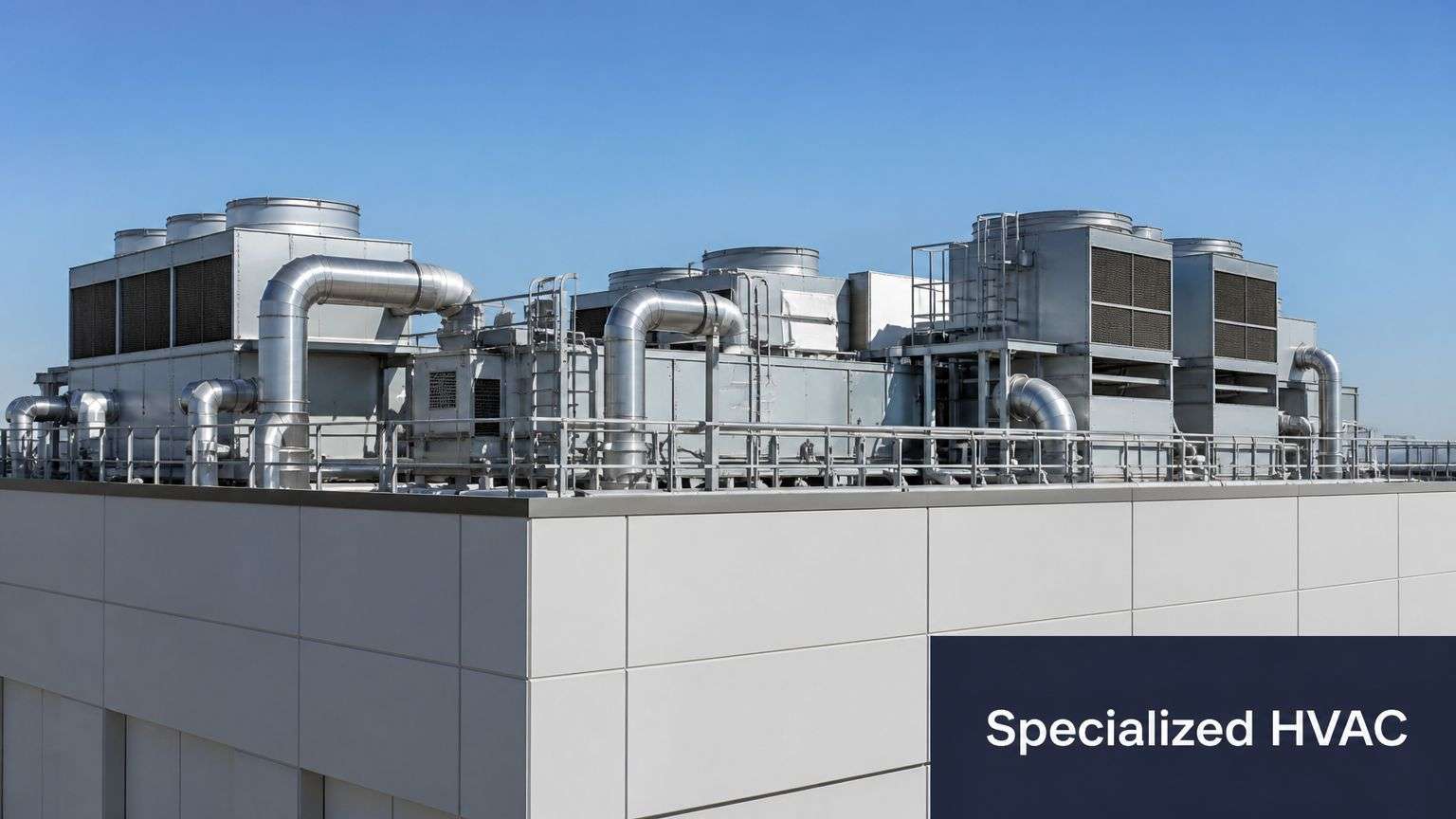
A lot of commercial buildings in Jenison rely on rooftop units because they keep equipment off the floor, free up interior space, and make it easier to serve larger open areas. That setup works well, but only when the contractor understands commercial access, curb conditions, controls, ventilation settings, and the way rooftop equipment interacts with the rest of the building.
Why rooftop units need commercial-specific service
Rooftop units aren't just larger residential systems. They often handle heating, cooling, ventilation, and outside-air management in one package. If the economizer is out of adjustment, if dampers aren't working, or if a control sequence is wrong, the building can get uncomfortable even when the compressors and burners are technically operating.
On retail, office, and light industrial properties in Jenison and Grandville, common rooftop problems include:
- Access-related delays: Roof access, weather exposure, and staging can turn a simple repair into a longer service call.
- Ventilation issues: Outdoor air settings that are too low can leave the space stale. Settings that are too aggressive can drive up operating costs.
- Control drift: Sensors, actuators, and scheduling problems often create comfort complaints that look like equipment failure.
Businesses evaluating rooftop solutions can review commercial rooftop HVAC unit options to understand where packaged systems fit best and where a more customized approach may make more sense.
Multi-unit properties require tighter coordination
Apartment buildings, mixed-use sites, and other multi-tenant properties create a different service challenge. One building may have several pieces of equipment, different lease responsibilities, varied comfort expectations, and staggered equipment ages. A contractor has to manage more than mechanical work. They have to manage access, scheduling, documentation, and tenant disruption.
In those properties, the hard part isn't always the equipment. It's keeping one complaint from turning into ten.
A few issues show up repeatedly:
| Property type | Common HVAC concern | Service priority |
|---|---|---|
| Apartment buildings | Unit-to-unit inconsistency | Restore comfort without repeated callbacks |
| Multi-tenant retail | Different occupancy patterns | Match zones and schedules to actual use |
| Office suites | Hot and cold spots | Verify airflow and controls before replacing equipment |
For systems serving larger commercial footprints, commissioning becomes especially important. When systems exceed the thresholds noted in the verified brief, proper commissioning tied to ASHRAE standards helps confirm pressure integrity, safety compliance, and sequence performance. Skipping that step is where long-term reliability starts to break down.
The Value of Proactive HVAC Maintenance
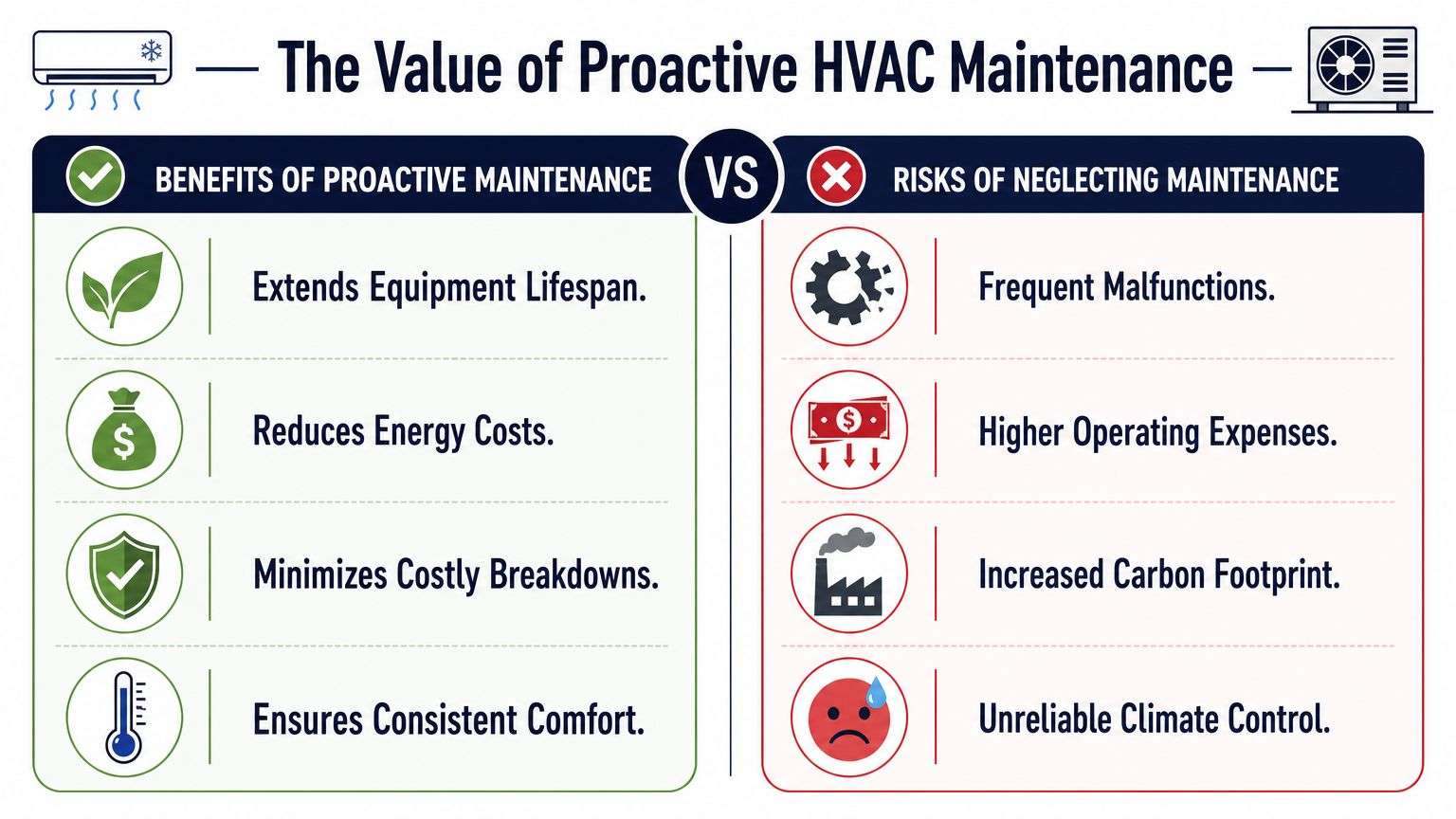
The cheapest time to deal with a commercial HVAC problem is usually before anyone in the building notices it. Maintenance doesn't eliminate every failure, but it catches a lot of the wear, dirt buildup, control drift, and airflow problems that push systems toward emergency service.
What preventive work actually prevents
A commercial system rarely goes from perfect to dead with no warning. More often, it gets louder, less balanced, slower to satisfy, less consistent across zones, or harder to control during weather swings. Preventive work is where a technician catches those early signs and corrects them before they become an operational problem.
That matters even more when HVAC performance overlaps with building envelope issues. If you manage a property, Penn Ohio's commercial roof maintenance advice is a useful reminder that roof condition and rooftop equipment performance are connected. Water intrusion, curb issues, and neglected roof penetrations can create mechanical and comfort problems that don't show up on a thermostat screen.
A practical maintenance visit should include attention to:
- Airflow health: Dirty filters, slipping belts, blocked coils, and duct issues all reduce system performance.
- Control accuracy: Schedules, sensors, and staging logic need to reflect how the building is used.
- Seasonal readiness: Heating components need a proper pre-winter check, and cooling components need a pre-summer check before occupancy complaints start.
Field note: Businesses usually don't call because a bearing is wearing out. They call when comfort drops, noise increases, or the system quits during occupied hours.
Maintenance is cheaper than disruption
The primary value of maintenance is predictability. Managers can budget for planned service. They can't budget for a conference room that's unusable, a retail floor that feels muggy, or multiple tenant complaints landing in one afternoon.
For companies that want a scheduled approach, commercial HVAC maintenance plans can structure inspections, tune-ups, and priority response around the building's actual operating cycle. Platinum Heating & Cooling offers a maintenance membership built around that model, with scheduled service and priority-based support for ongoing care.
What works well is simple:
- Service before the season, not after the first breakdown.
- Track repeat issues by zone or unit, not just by invoice.
- Replace worn components when they start affecting operation, not when they finally fail.
What doesn't work is waiting until the first hard freeze or humid stretch to find out which system was barely hanging on.
How to Choose a Commercial HVAC Contractor in Jenison
A commercial HVAC contractor should be able to explain the building, not just the equipment. If every recommendation starts and ends with replacing the unit, that's a warning sign. Commercial work often depends on controls, ventilation, load, scheduling, and occupancy patterns as much as the box on the roof or in the mechanical room.
What to verify before you sign anything
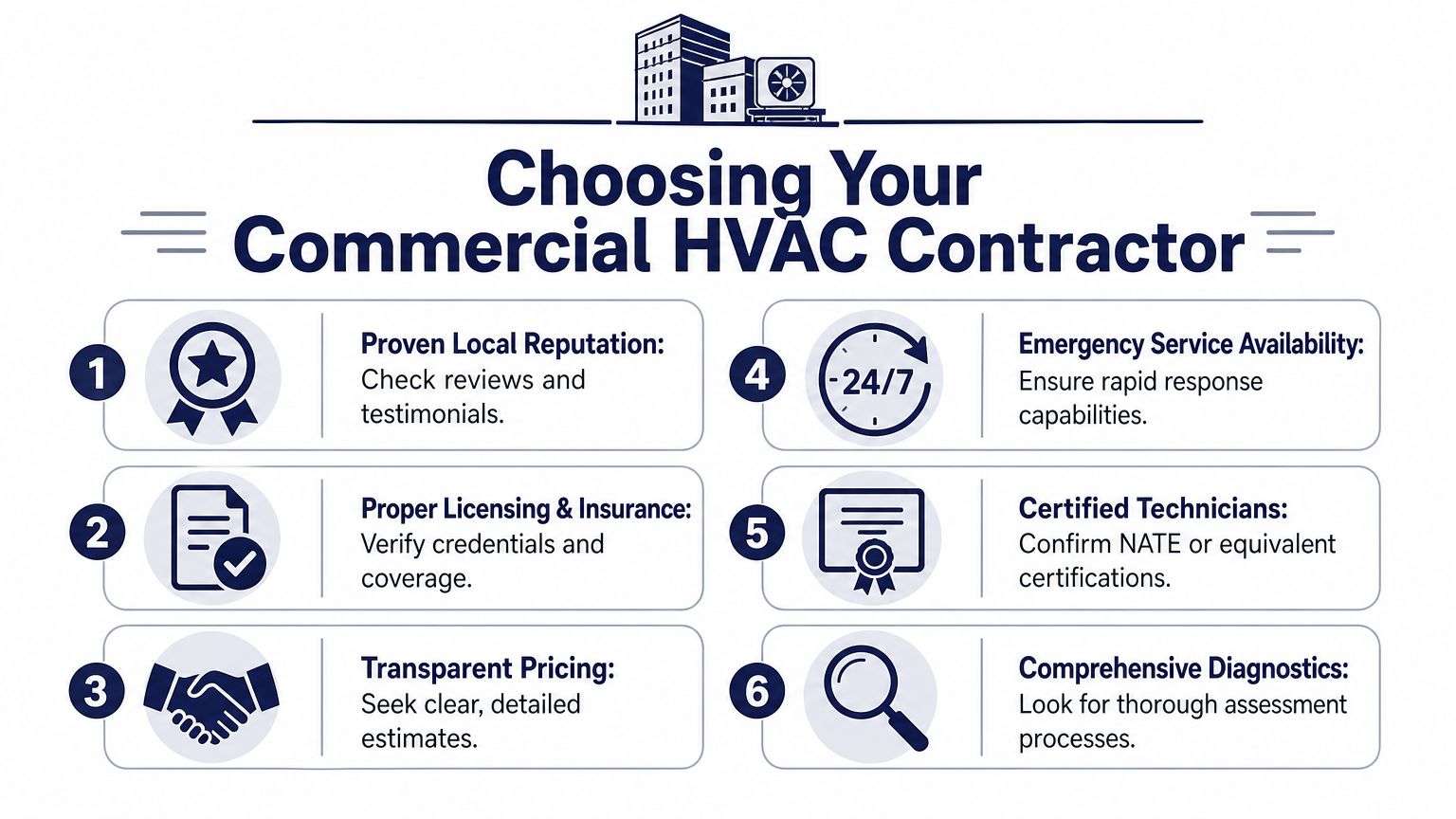
Start with the credentials that determine whether the contractor can legally and competently perform the work.
A valid Michigan Mechanical Contractor license from LARA is required to legally handle refrigerant documentation and safety compliance on commercial systems, according to the verified regulatory guidance in the project brief. For larger systems, commissioning tied to ASHRAE standards is also critical. The same verified brief states that skipping commissioning on systems over 10,000 square feet can lead to a 25 percent increase in premature failure rates and a 10 to 15 percent reduction in energy efficiency.
That makes the first screening checklist straightforward:
- License verification: Ask whether the company holds the required Michigan mechanical licensing for the scope of work.
- Commercial experience: Make sure they regularly work on rooftop units, boilers, split systems, and multi-zone commercial controls.
- Emergency response capability: Businesses in Jenison, Wyoming, and Hudsonville need a contractor who can respond when a failure affects operations, not just when the schedule opens up.
If you're comparing providers in the area, a local HVAC contractor search page for West Michigan service can help confirm whether the company covers your municipality and the surrounding corridor.
Questions that reveal real commercial capability
The best interview questions are practical. Ask what they do before recommending replacement. Ask how they verify airflow, ventilation, and control function. Ask whether they handle commissioning documentation when the project requires it.
Then pay attention to the answer style.
| Question | Strong answer sounds like | Weak answer sounds like |
|---|---|---|
| How do you diagnose comfort complaints? | Discusses load, airflow, controls, and occupancy | Jumps straight to replacing equipment |
| What do you check on larger installations? | Mentions plans, layout, commissioning, and compliance | Stays vague about process |
| How do you support emergencies? | Explains response path and triage | Gives a generic promise |
Hire the contractor who can explain why the problem happened and how they'll verify the fix.
Key Factors That Influence Service Pricing
Commercial HVAC pricing varies because the work itself varies. Two buildings can both need “an HVAC repair” and still require completely different labor, access, materials, testing, and follow-up. A fair quote should reflect building conditions and the actual scope, not just a flat assumption based on tonnage or equipment age.
What changes the cost of a job
System type matters first. A simple split system is not priced like a rooftop unit with ventilation controls, and neither is priced like a hydronic or multi-zone setup. Building access also matters. Roof work, occupied tenant spaces, after-hours scheduling, crane coordination, and restricted service windows all add complexity.
Age and condition change the picture too. Older systems often need more diagnostic time because one failed part may not be the only issue. Dirty coils, deteriorated wiring, airflow restrictions, and improvised previous repairs can turn a routine call into a deeper correction.
The biggest technical cost driver is design accuracy. Oversized equipment often comes from bad load assumptions, and that doesn't just affect comfort. The verified design brief states that poor sizing can raise utility costs by 15 to 20 percent because oversized systems cycle too frequently and handle humidity poorly. For larger projects in Michigan, licensed mechanical engineering review may also be required.
Low bids often miss the expensive part
The cheapest quote can leave out the work that protects long-term performance. That may mean weak load calculations, minimal duct review, no real control strategy, or a replacement plan that ignores ventilation and zoning.
Business owners can make better buying decisions when they understand how contractors position their services locally. For that reason, Transactional LLC's HVAC SEO insights are useful reading. Not as a mechanical source, but as a reminder to look past surface-level marketing and evaluate whether a contractor clearly explains scope, service area, and commercial capability.
A good quote should answer basic business questions:
- What problem is being solved
- What work is included
- What assumptions the quote depends on
- What may need correction after inspection or startup
If those answers aren't clear, the price isn't clear either.
Frequently Asked Questions About Commercial HVAC
A Jenison business can have a building full of comfort complaints while the equipment is still running. In many of those calls, the root issue is indoor air quality, ventilation, or humidity control, not a failed furnace or air conditioner.
That distinction matters in West Michigan. Winter pushes buildings to stay closed up, which can trap stale air and dry out occupied spaces. Summer brings humidity, heavier cooling demand, and complaints that sound like an AC problem even when the actual issue is outside air control or poor airflow.
What MERV or HEPA means in a commercial space
MERV and HEPA ratings describe how well a filter captures particles. They do not tell you whether a given system can handle that filter without losing airflow.
A higher-rated filter can improve air quality, but it also increases resistance across the filter bank. If the fan, duct system, or rooftop unit is already near its limit, that filter upgrade can create new problems. Rooms may get stuffy. Some areas may go positive or negative on pressure. Heating and cooling performance can slip even though the filter change looked like the right move on paper.
In offices, medical-adjacent suites, schools, retail spaces, and multi-tenant buildings, filtration has to match the equipment and the use of the space. Good commercial HVAC work means checking fan capacity, filter rack condition, outside air settings, and occupancy patterns before recommending a higher-efficiency filter.
How to tell if the problem is ventilation, not cooling
Ventilation problems usually show up in a different way than straight cooling failures. Staff may say the air feels stale. Odors linger after a room empties. One conference room gets uncomfortable every time it fills up, even though the thermostat reading looks normal.
Cooling problems are usually more direct. The space misses setpoint, struggles in the afternoon sun, or never recovers after doors open and close through the day.
A few signs point more toward IAQ or ventilation issues:
- The room feels stale even at a normal temperature
- Odors hang around longer than they should
- Humidity complaints continue while cooling is running
- Conditions get worse as occupancy increases
- One zone is uncomfortable while nearby areas seem fine
Those symptoms often trace back to outside air delivery, return airflow, economizer operation, control settings, or filtration choices. They are common in older commercial buildings around Jenison where tenant changes, remodels, and years of service calls have shifted the system away from how it was originally set up.
If recurring comfort issues keep affecting staff, tenants, or customers, ask for an evaluation that includes ventilation, humidity control, filtration, and airflow. A refrigerant check alone will not solve an air quality problem.
If your building needs commercial heating, cooling, ventilation, rooftop unit service, or a second opinion on recurring comfort issues, contact Platinum Heating & Cooling to schedule service in Jenison and across West Michigan, including Hudsonville, Grandville, Walker, Standale, Allendale, and Wyoming, Michigan.