
Your building is open, staff is on site, tenants are calling, and one part of the property feels stuffy while another feels cold. Then the utility bill lands, and it's higher than you expected again. That's a familiar problem for business owners and property managers dealing with commercial HVAC in Grand Rapids.
In West Michigan, including Hudsonville, Jenison, Grandville, Walker, Standale, Allendale, & Wyoming michigan, HVAC decisions affect more than comfort. They affect tenant satisfaction, equipment life, operating budgets, and whether your business can stay productive during weather swings. During the northern winter months from November through April, heating reliability becomes the first concern. In the remaining months, cooling performance, humidity control, and airflow usually take over.
Many owners often get stuck. They know they need service, repair, replacement, or a retrofit, but they don't always know what matters most locally. In Grand Rapids, the useful questions are often about rooftop units, cold-weather heat pump performance, rebate timing, and what happens when winter grid stress creates new risks for commercial facilities.
Table of Contents
- Introduction to Commercial HVAC in West Michigan
- Core Concepts of Commercial HVAC Services
- Common Commercial HVAC Systems Explained
- Signs You Need Service or Replacement
- Energy Efficiency Upgrades and Retrofit Process
- Maintenance Plans and Emergency Response Strategies
- Pricing Factors and Local Code Requirements
- Case Studies and Clear Calls to Action
Introduction to Commercial HVAC in West Michigan
A Grand Rapids facility manager might start the day with three different complaints. One office suite is warm, a retail front is drafty, and a rooftop unit keeps short cycling when the weather turns. By noon, the manager is deciding whether to patch the system again or start planning a smarter upgrade.
That's why commercial HVAC isn't just a mechanical issue. It's an operations issue. If a building can't hold stable temperatures, people notice fast. Employees lose focus, customers leave sooner, and tenants start asking harder questions about maintenance.
In West Michigan, including Hudsonville, Jenison, Grandville, Walker, Standale, Allendale, & Wyoming michigan, that pressure changes with the season. From November through April, heating systems carry the load and any weakness shows up quickly. Outside those winter months, owners usually shift toward cooling output, humidity, ventilation, and indoor comfort across multiple zones.
A commercial HVAC system works like the circulatory system of a building. If airflow, controls, or heating capacity fall out of balance, the whole building feels it.
Core Concepts of Commercial HVAC Services
Commercial HVAC covers far more than emergency repair. It includes system design, installation, retrofits, controls, airflow balancing, preventive maintenance, and replacement planning for offices, retail buildings, industrial spaces, healthcare settings, and multi-unit properties.
What commercial service actually includes
Think of commercial service in layers.
The first layer is design and sizing. Contractors look at how the building is used, where heat loads build up, how many zones need control, and whether the duct layout supports the equipment. A warehouse office, a restaurant suite, and an apartment corridor all behave differently, even if their square footage looks similar on paper.
The second layer is installation and retrofit work. That can mean replacing an old rooftop unit, adding controls to improve zoning, or adapting existing ductwork so a newer system can operate correctly. Retrofit jobs often require more planning than new construction because the new equipment has to work around an older building's limits.
The third layer is ongoing maintenance and troubleshooting. That includes filter changes, coil cleaning, belt inspection, refrigerant checks, control testing, and verifying airflow. Commercial systems rarely fail from one dramatic event. More often, they drift out of spec slowly until energy use rises and comfort drops.
Why local market density matters
The Grand Rapids-Wyoming-Kentwood metro area serves 1,162,950 residents with 341 HVAC contractors, or 29.3 contractors per 100,000 people, according to Grand Rapids market data from Market Unlock. For building owners, that means the local market is active and competitive.
That doesn't guarantee every contractor handles commercial work the same way. It does mean businesses in the region usually have access to a broad service network for repairs, rooftop equipment, apartment systems, and construction-related projects.
How the calendar changes the workload
In West Michigan, the service calendar has a clear rhythm.
- November through April: Heating becomes the priority. Owners focus on ignition reliability, heat output, freeze-related problems, and whether equipment can maintain indoor comfort during cold snaps.
- The rest of the year: Cooling and ventilation move to the front. Attention shifts toward compressor operation, dehumidification, thermostat coordination, and consistent airflow to occupied zones.
- Shoulder seasons: Spring and fall are often the best times for inspections, tune-ups, and replacement planning because emergency demand is usually less intense.
Practical rule: Don't judge a commercial system by whether it turns on. Judge it by whether it delivers the right temperature, airflow, and control where people actually work.
Service coverage across West Michigan
A practical commercial HVAC plan also depends on geography. Regional work often spans West Michigan, including Hudsonville, Jenison, Grandville, Walker, Standale, Allendale, & Wyoming michigan. Those towns form a service corridor where technicians need the right inventory, scheduling discipline, and familiarity with local permit routines to keep projects moving.
Common Commercial HVAC Systems Explained
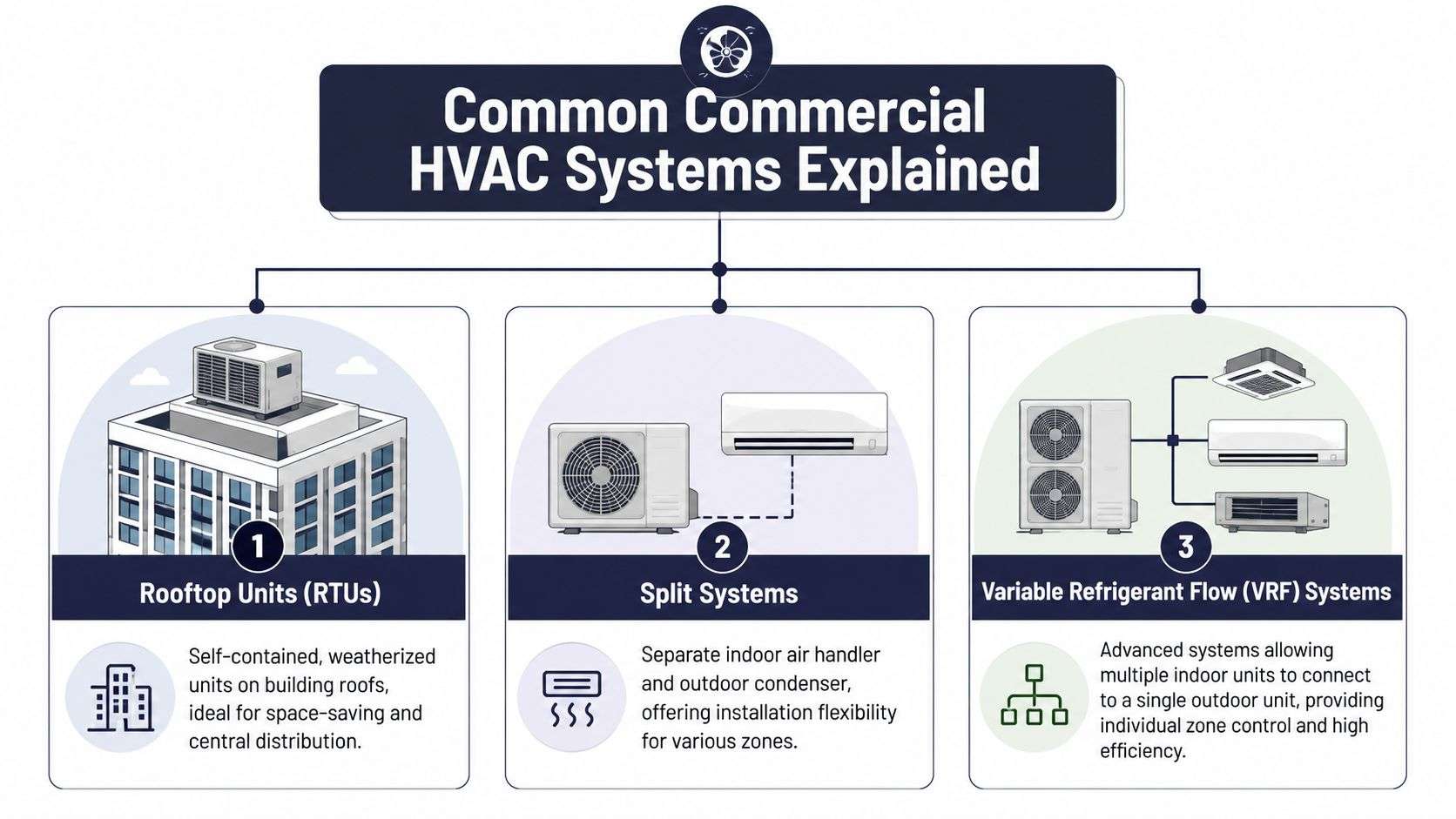
Commercial buildings in Grand Rapids usually rely on a few common system types, but owners often hear the names without getting a plain explanation of what each one is built to do.
Rooftop units
Rooftop units, or RTUs, are common on retail buildings, offices, and light commercial facilities. They place major components in one weatherized cabinet on the roof, which saves indoor floor space and can simplify service access.
That setup makes sense for many properties in commercial HVAC Grand Rapids work because it keeps equipment out of tenant areas and supports central air distribution. If you want a closer look at how these systems are used in local projects, this overview of commercial rooftop HVAC units is a useful starting point.
RTUs still need regular attention. Filters, belts, economizers, coils, and drains can all affect performance. A rooftop system that's ignored may still run, but it won't run well for long.
Light commercial heat pumps
Heat pumps confuse many owners because they sound simple until winter arrives. In Michigan, a light commercial heat pump needs to hold up in low temperatures, not just mild weather.
According to Energy Star light commercial HVAC criteria, light commercial heat pumps must achieve a COP of at least 1.75 at 5°F and retain 70% of heating capacity at 5°F compared to 47°F to stay reliable in cold winters. That matters in Grand Rapids because a unit that loses too much output in the cold can leave a building uncomfortable right when heating is most critical.
Multi-unit and zoned systems
Apartment buildings, shopping centers, and office suites often need multiple zones rather than one blanket temperature. A system may serve one wing, one floor, or one tenant area separately so occupants don't compete over the thermostat.
These setups work best when airflow and controls are tuned carefully. Good zoning gives you flexibility. Bad zoning gives you hot and cold calls all week.
The right system isn't the most complex one. It's the one that fits the building layout, the seasonal load, and the way the space is actually occupied.
Signs You Need Service or Replacement
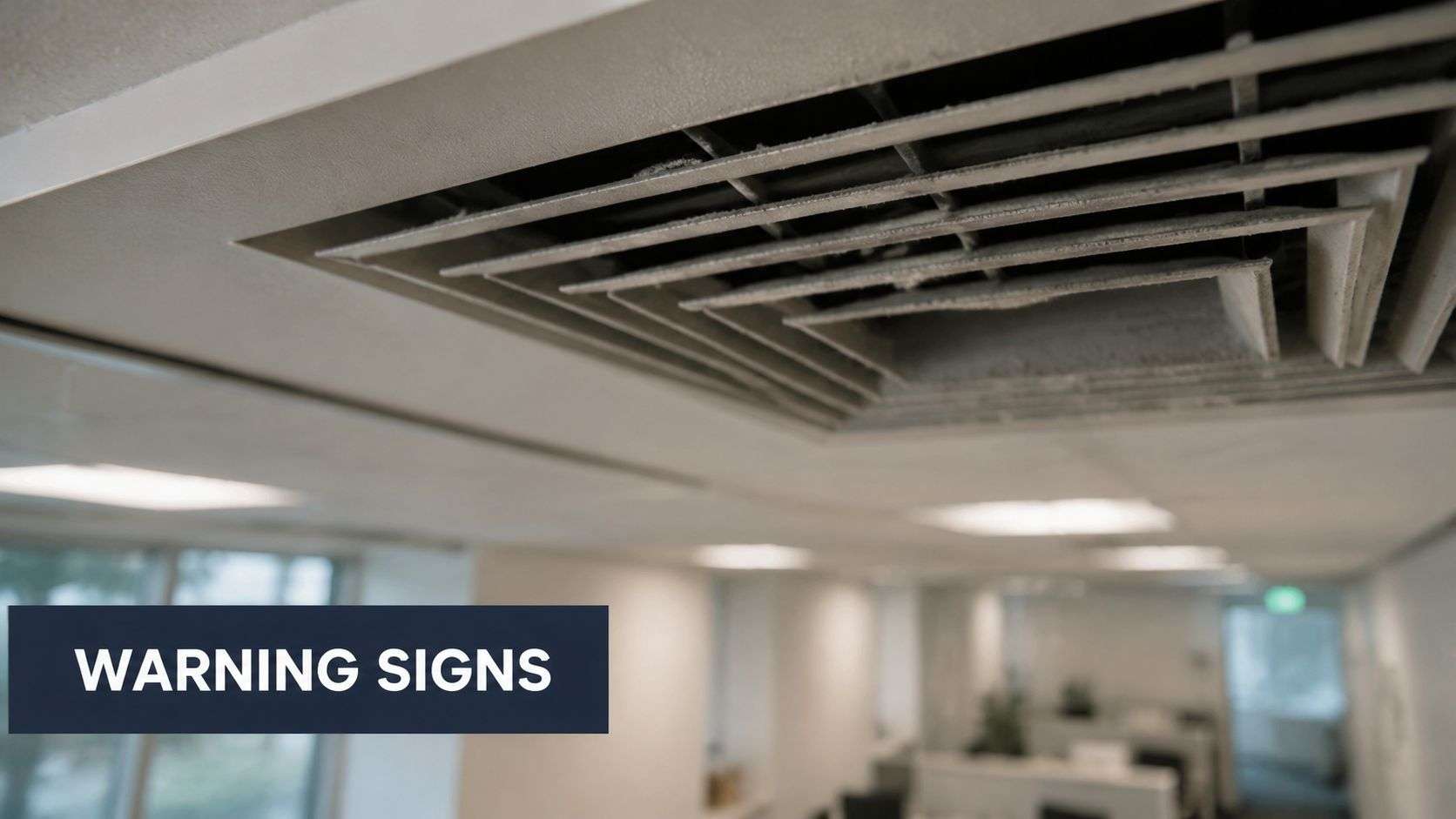
Many commercial systems don't fail all at once. They give warnings first. The problem is that busy managers often normalize those warnings until the equipment stops at the worst possible time.
What to watch during daily operation
Start with what occupants notice.
- Uneven rooms: One area feels fine while another stays hot, cold, or muggy.
- Strange sounds: Rattling, grinding, banging, or hissing often points to loose parts, motor trouble, or refrigerant issues.
- Frequent cycling: The system starts and stops too often instead of running in steady, efficient intervals.
- Rising utility bills: If usage patterns haven't changed much, the system may be working harder than it should.
Airflow deserves special attention. According to California building HVAC requirements, airflow below 350 CFM per ton of cooling capacity can increase energy waste by 20 to 30% and accelerate component wear. In plain terms, low airflow is like making an engine run while blocking part of the exhaust path. Parts heat up, efficiency falls, and wear arrives sooner.
Heating warnings versus cooling warnings
From November through April, heating problems often show up as delayed ignition, weak heat, frozen coils, or rooms that never recover after doors open and close throughout the day. If a tenant says, “The thermostat says it's heating, but the space never catches up,” that's a serious clue.
Outside the winter season, cooling trouble often looks different. The building may reach the thermostat setting only part of the day, or it may feel clammy even when the temperature number looks acceptable. That usually points to poor dehumidification, weak airflow, or a control issue.
A simple decision checklist
Use this quick test:
- If the issue is sudden and building-wide, call for urgent service.
- If comfort problems repeat in the same zones, request a diagnostic review.
- If repairs keep stacking up, ask for replacement options instead of another patch.
- If airflow is weak at multiple vents, don't assume it's only a dirty filter.
Energy Efficiency Upgrades and Retrofit Process
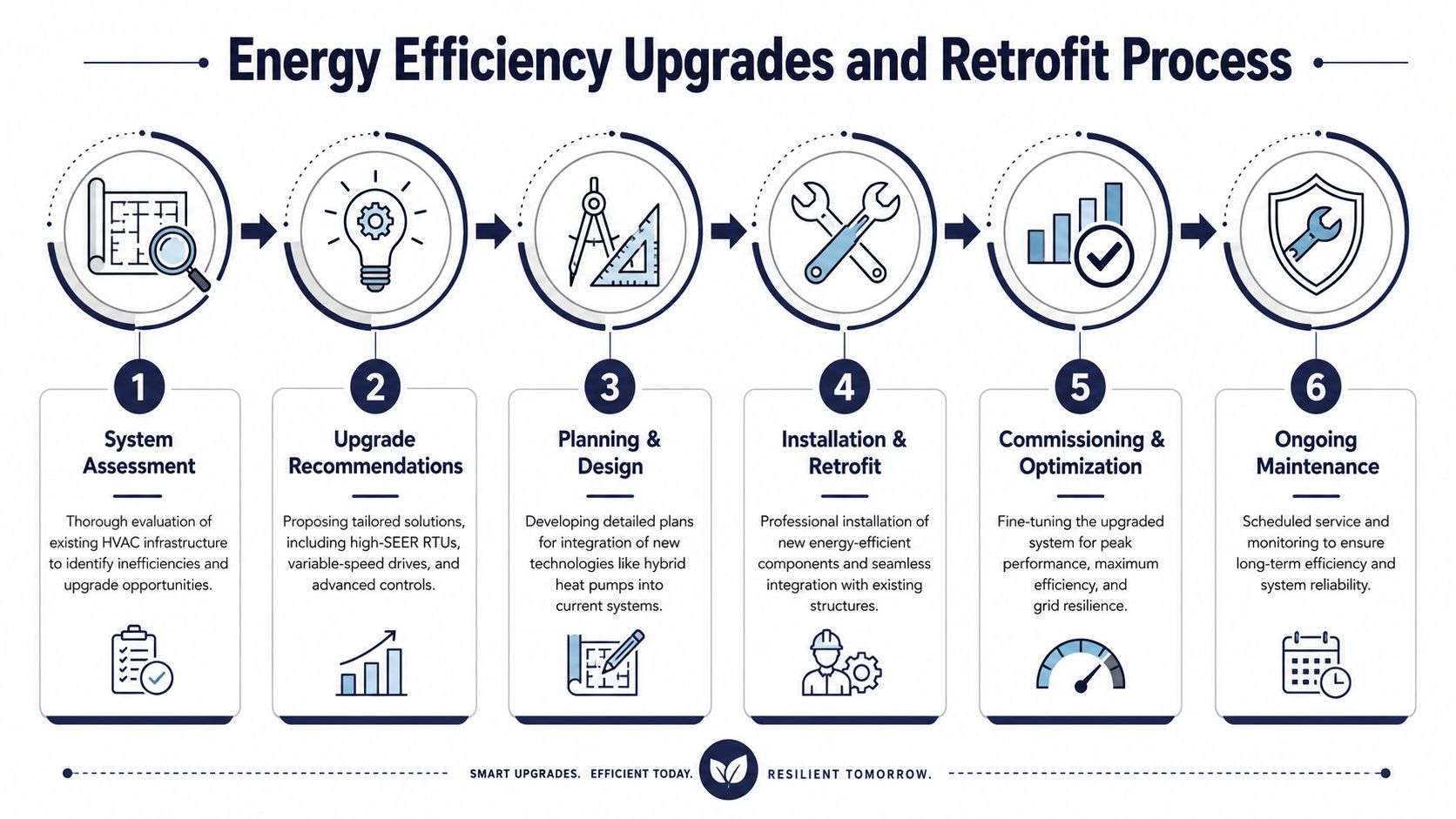
Efficiency upgrades make sense when an older system still runs but wastes energy, struggles to control zones, or creates repeated service calls. In Grand Rapids, the smarter retrofit conversation isn't just about equipment. It's also about rebate timing, cold-weather performance, and resilience during winter grid stress.
What owners usually upgrade first
Most retrofit projects start with one or more of these moves:
- Rooftop unit replacement: Older RTUs are often replaced when repair frequency rises or controls become unreliable.
- Variable-speed components: These help equipment match load changes more smoothly instead of running at one fixed output.
- Control upgrades: Better scheduling and zoning reduce the “empty room conditioning” that drives waste.
- Hybrid heating setups: Pairing a heat pump with gas backup can support reliability during hard winter conditions.
The hybrid approach gets more attention now because resilience matters alongside efficiency. A building owner may accept slightly more planning upfront if the resulting system can keep operations steadier when conditions get rough.
Why rebates change the math
According to Michigan commercial HVAC rebate discussion and EERF context, utility rebate program changes in 2025 through 2026 significantly affect the payback period for rooftop unit retrofits under Michigan's Energy Efficiency Revolving Fund, yet few local resources quantify these effects. That's a practical issue for owners of multi-unit properties, offices, and retail spaces trying to decide whether an upgrade penciled out last year still makes sense now.
The important lesson is simple. Don't assume the same rebate path will apply to every building or every equipment class. Rebate structures can change project timing, equipment selection, and how quickly an owner sees value from the retrofit.
If you're comparing old and new equipment, compare the full project path, not just the unit itself. Controls, permits, commissioning, and rebate paperwork all affect the real outcome.
For technical field verification during equipment assessment and startup, it also helps to understand how technicians compare HVAC meters. You don't need to become an instrument expert, but knowing what gets measured makes retrofit proposals easier to evaluate.
A workable retrofit sequence
A clean retrofit process usually follows this order:
Site assessment
A technician or engineer reviews equipment condition, building use, control problems, and seasonal load patterns.Recommendation review
Owners compare options such as RTU replacement, control upgrades, or hybrid heating configurations.Rebate and paperwork check
Before installation, the team confirms what incentive path applies and what documentation is required.Permit coordination
Mechanical work often needs local approval, especially when equipment size, gas components, or control changes are involved.Installation and commissioning
The new system is installed, tested, and adjusted so airflow, controls, and operating sequences match the design intent.Ongoing service planning
A retrofit only holds its value if filters, coils, sensors, and seasonal settings stay in shape.
Platinum Heating & Cooling offers commercial installation, repair, and maintenance options for businesses that need one provider to handle assessment, retrofit planning, and post-installation upkeep.
Maintenance Plans and Emergency Response Strategies
A maintenance plan doesn't eliminate every emergency, but it does reduce the number of avoidable ones. That's a major difference for offices, apartment properties, retail spaces, and light industrial buildings that can't afford repeated downtime.
What preventive maintenance actually does
Scheduled service catches the quiet problems. Filters load up. Belts loosen. Drain lines clog. Sensors drift. None of those issues sounds dramatic on its own, but together they make a building less comfortable and more expensive to run.
A structured service plan usually includes seasonal inspections, filter changes, cleaning, operating checks, and priority dispatch when trouble appears. For owners comparing plan options, these commercial HVAC maintenance plans show the kind of preventive framework many businesses use to stay ahead of shutdowns.
There's also a planning benefit. When a contractor sees the same equipment repeatedly, they can spot patterns instead of only reacting to the latest symptom.
Emergency response is more than repair
Emergency planning has changed in West Michigan because winter reliability now includes grid-related risk, not just equipment failure. According to Grand Rapids HVAC guidance on winter system planning, 68% of commercial facility managers now prioritize grid resilience through hybrid RTU and gas backup configurations after the 2024 to 2025 Michigan winter grid instability.
That matters most during November through April, when heating continuity affects occupancy and safety. If the building depends on one heating path and that path is interrupted, the problem can move quickly from comfort issue to operations issue.
A resilience checklist for property managers
Use this list before winter arrives:
- Confirm backup strategy: Know whether your heating setup includes a secondary heat source or contingency path.
- Review control sequences: Make sure building staff understands how the system behaves during outage recovery or partial operation.
- Check access and roof readiness: Emergency crews lose time when roof hatches, ladders, or unit clearances aren't ready.
- Plan temporary heat procedures: If your building requires temporary heating, know the safety and approval steps in advance.
- Keep tenant communication ready: Occupants tolerate disruption better when they get clear updates early.
Buildings don't stay operational during winter stress by accident. Someone has to plan for the failure path before the failure happens.
Pricing Factors and Local Code Requirements
Commercial HVAC pricing can frustrate owners because two projects that sound similar often come back with different proposals. That usually happens for a good reason. The final number is shaped by equipment type, building conditions, controls, access, permits, and how much retrofit work hides behind the visible equipment swap.
What drives cost
A straightforward roof replacement is one thing. A project that also needs curb changes, gas work, electrical updates, controls integration, and after-hours scheduling is something else entirely.
Common pricing drivers include:
- System type: Rooftop equipment, split systems, and multi-zone setups carry different labor demands.
- Capacity and efficiency level: Higher-efficiency equipment may require additional planning or integration work.
- Access conditions: Roof access, tenant occupancy, crane coordination, and limited work windows can affect labor.
- Code compliance: Mechanical permits, inspections, and required corrections all shape the total scope.
- Maintenance baseline: Poor existing condition often increases startup and balancing work after installation.
If you're trying to budget proactively, this breakdown of commercial HVAC maintenance cost factors helps frame what owners should ask before approving long-term service.
Typical Commercial HVAC Cost Factors
| Cost Item | Low Estimate | High Estimate |
|---|---|---|
| Equipment scope | Varies by building and system type | Varies by building and system type |
| Labor complexity | Lower for simpler access and direct replacement | Higher for retrofits, controls, or difficult access |
| Permit and inspection requirements | Lower when scope is limited | Higher when multiple code checkpoints apply |
| Controls and commissioning | Basic setup | Advanced integration and balancing |
| Downtime coordination | Minimal scheduling impact | Added planning for occupied properties |
The table is qualitative on purpose. Real pricing depends on site conditions, and owners should be cautious of any proposal that treats a commercial replacement like a one-size-fits-all package.
Local code and permit realities
In West Michigan, including Hudsonville, Jenison, Grandville, Walker, Standale, Allendale, & Wyoming michigan, permit expectations and inspection flow can differ by municipality even when the mechanical work looks similar. Contractors need to account for local submission steps, inspection timing, rooftop access rules, and any required corrections before closeout.
For owners managing broader renovation projects, non-HVAC planning can also affect schedule and budget. This guide to UK office fit out planning is helpful as a general example of how buildout decisions ripple through a project, even though local code and pricing rules in Michigan are different.
Case Studies and Clear Calls to Action
The most useful commercial HVAC stories are usually the simplest ones. A building had a comfort problem, the underlying cause was identified, and the owner chose between repeated repairs and a more stable long-term fix.
Two local scenarios owners will recognize
A retail property in Grandville might struggle with uneven temperatures between the storefront and rear work area. In a situation like that, the visible complaint is comfort, but the deeper issue is often aging controls, weak airflow, or a rooftop unit that no longer matches the way the space is used. A proper assessment can turn a cycle of tenant complaints into a defined repair-or-retrofit decision.
A small office in Walker can face a different kind of pressure during the winter months. Heat loss overnight, lockout conditions, or ignition trouble can force an urgent response before staff arrive. In those cases, the best outcome isn't just “heat is back.” It's having a documented cause, a parts and maintenance plan, and a realistic view of whether the equipment should remain in service.
What business owners should do next
Many owners wait too long because they think the choice is either emergency repair today or total replacement tomorrow. Usually there's a middle ground.
- Request a site assessment: This is the right move when comfort issues repeat and no one has diagnosed the full system.
- Ask for maintenance planning: If the equipment still has service life, preventive care may stabilize performance and reduce disruption.
- Review upgrade timing: If rebates, code changes, or winter resilience matter to your operation, planning early gives you more control.
- Improve communication expectations: Good service isn't only technical. It also depends on updates, scheduling clarity, and follow-through. This article on improving customer service communication offers a useful framework for thinking about what responsive support should look like in any service relationship.
A commercial HVAC partner should help you make a clear decision, not just hand you a repair ticket. If your building serves tenants, employees, customers, or residents, HVAC planning is part of protecting the way that building performs every day.
If you need help with commercial HVAC in Grand Rapids or anywhere in West Michigan, Platinum Heating & Cooling can schedule a site assessment, discuss maintenance membership options, or provide a quote for repair, replacement, or retrofit planning.