
When the cold finally settles in across West Michigan, usually from November through April, a furnace humidifier that suddenly quits is a common headache. From my experience, it almost always points to one of a few usual suspects: a clogged water panel, a fried solenoid valve, or a bad humidistat. Figuring out which one is the problem is always the first, most important step before you can even think about a repair.
Why Your Humidifier Stops Working in West Michigan Winters
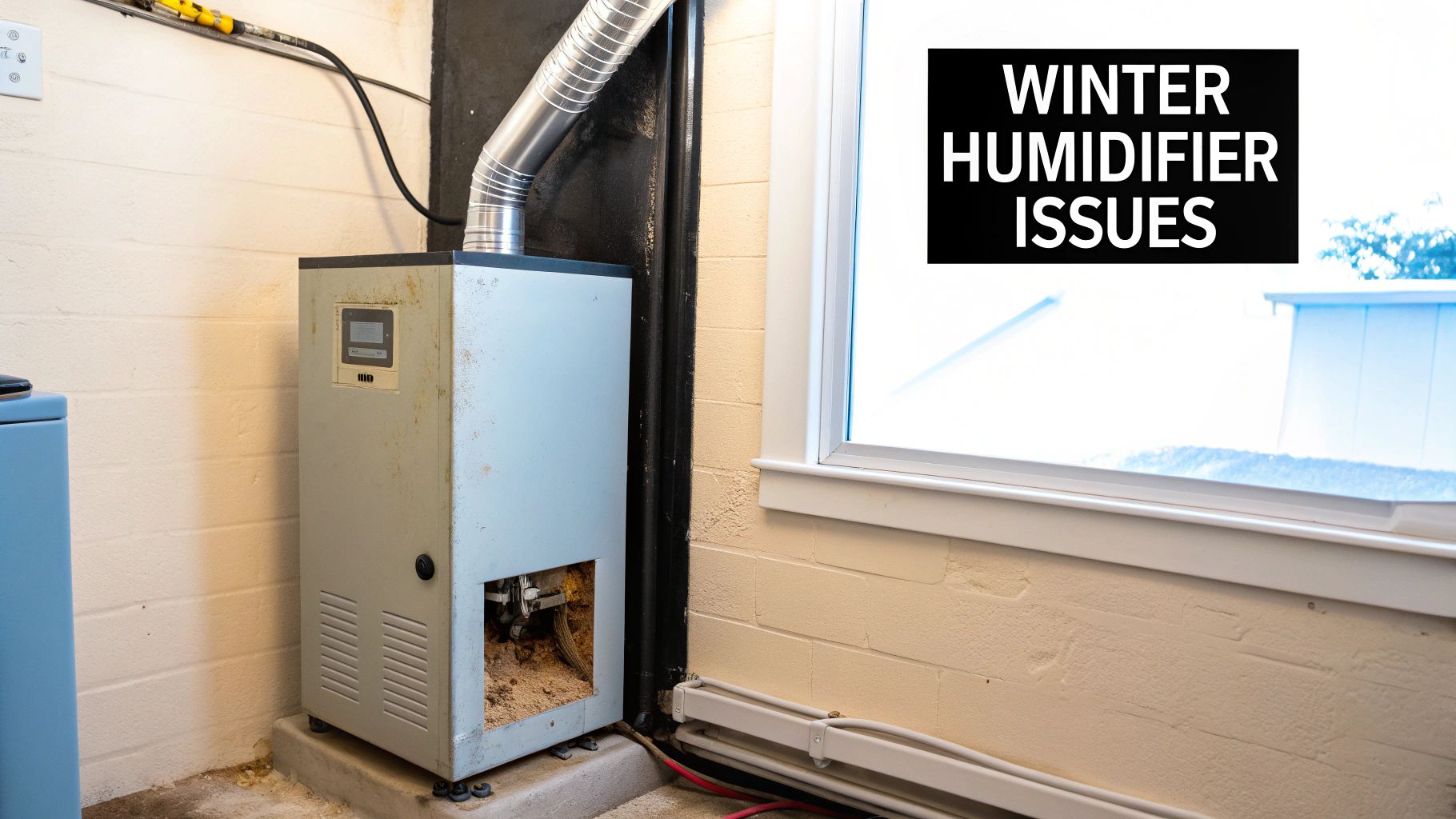
During our long northern winter months, usually from November through April, your furnace is running nearly nonstop. That constant use puts a huge strain on your whole-house humidifier, a small but vital piece of equipment for keeping your indoor air comfortable. When it gives out, you feel the effects right away.
You’ll start noticing little things. An annoying zap of static electricity every time you touch a doorknob. Your skin feels dry and itchy. Maybe your wood floors and furniture start creaking and showing small gaps. These are all classic signs that your home’s humidity has plummeted, and your humidifier is likely the culprit. Homeowners in West Michigan, including Hudsonville, Jenison, Grandville, Walker, Standale, Allendale, & Wyoming michigan, all call us with the same issues, which are often tied directly to our region's specific conditions.
Common Furnace Humidifier Symptoms And Likely Causes
To help you narrow down the issue before you even pick up a tool, here’s a quick-glance table I put together. It connects what you're seeing (and feeling) at home to the most probable cause.
| Symptom You Notice | Most Likely Cause | Quick Check You Can Do |
|---|---|---|
| Bone-dry air, humidifier is silent. | No Power: A tripped breaker, loose wire, or furnace issue. | Check your home's breaker panel. Ensure the humidifier's power plug is secure. |
| Humidifier fan runs, but air is still dry. | No Water: The water supply valve is off or the water line is clogged. | Find the small saddle valve on your water pipe and make sure the handle is parallel to the pipe (open). |
| You see water leaking or pooling around the furnace. | Clogged Drain or Panel: Mineral buildup is blocking the drain tube or water panel, causing an overflow. | Inspect the small drain tube at the bottom of the humidifier for kinks or blockages. |
| The unit seems to run constantly or not at all. | Faulty Humidistat: The control dial isn't reading the humidity correctly. | Try turning the humidistat dial all the way up. If it doesn't click on, the control may be bad. |
| Air feels dry, and you hear a "buzzing" noise. | Bad Solenoid Valve: The valve that lets water in is stuck closed or failing. | When the furnace and humidifier are running, carefully touch the solenoid valve. You should feel a slight click or vibration. |
Think of this table as your starting point. It’s a simple diagnostic tool that can save you a lot of time and frustration by pointing you in the right direction from the get-go.
Common Culprits Behind a Failed Humidifier
The notoriously hard water we have in areas like Hudsonville and Wyoming is your humidifier’s number one enemy. Over a single winter, mineral deposits can build up and completely choke the water panel (you might also hear it called an evaporator pad or filter), making it impossible for moisture to get into your air.
But it’s not just about mineral scale. Other mechanical parts can and do fail.
- No Power to the Unit: It sounds simple, but a loose wire or a tripped breaker can knock the whole thing offline. Sometimes, the problem is a bit deeper, originating from the furnace's own control board.
- Water Supply Issues: The small saddle valve that taps into your home’s water line can get clogged with sediment or just get turned off by accident, starving the humidifier of water.
- Faulty Humidistat: This is the brain of the operation. If the control dial that measures humidity goes bad, it simply won't tell the humidifier when it’s time to kick on.
In the crisp winters of West Michigan, where dry indoor air from furnace heating affects over 70% of homes, regional HVAC studies show furnace humidifier repairs have surged. A faulty unit isn't just annoying—it can spike energy costs by 15-20% as the overworked furnace compensates for dry air. Learn more about the market trends for humidifiers and their impact.
Just knowing what could be wrong makes the whole process feel less intimidating. You can’t fix a problem until you identify it, and having this knowledge turns a frustrating breakdown into a manageable project. The best way to avoid these headaches altogether is through regular fall furnace maintenance, which keeps every part of your system in check before winter hits.
Your Pre-Repair Toolkit and Safety Checklist
Before you even think about touching that humidifier, a few minutes of prep can be the difference between a quick, satisfying fix and a real headache. Trust me, jumping in without the right gear or a solid safety plan is just asking for trouble. A good DIY repair always starts with getting your ducks in a row.
First things first, let's get your tools together. This isn't a one-screwdriver job; you’ll need a few specific items to do it right. Having everything handy means no running back and forth to the garage, so you can stay focused.
Essential Tools for The Job
- Multimeter: This is your best friend for any electrical troubleshooting. It's the only way to know for sure if parts like the solenoid valve are getting power or if the furnace is sending the signal to turn on. It's a must-have, not a nice-to-have.
- Nut Driver Set: So many humidifier covers and internal parts are held on by hex-head screws. A good set of nut drivers, especially the ¼-inch and 5/16-inch sizes, will make your life a whole lot easier and save you from stripping screw heads.
- Small Bucket and Towels: You're working with water, so spills are going to happen. It's just a fact. Stick a small bucket under the unit and lay down some old towels. Our techs in Standale will tell you this simple step saves a ton of cleanup later.
- Pliers and Screwdrivers: A basic set of needle-nose pliers, along with both Phillips and flat-head screwdrivers, will handle just about everything else.
With your toolkit ready, we move on to the most important part: making absolutely sure the system is safe to work on. Never, ever underestimate this step. Powering everything down properly is more than just flipping one switch.
"The single biggest mistake we see homeowners make is assuming the system is off when it isn't. You must verify it at the source. It’s a simple step that prevents serious injury and protects your HVAC system from electrical damage."
Your Safety Shutdown Sequence
Start by turning off the humidistat itself—it's usually a small dial located near the furnace or on a wall nearby.
Next, find the main power switch for the furnace. It often looks just like a regular light switch on the side of the unit or on a wall close by. Flip it to the OFF position.
For complete peace of mind, head to your home's main electrical panel and shut off the circuit breaker that powers your furnace.
Finally, you need to cut the water. Look for the saddle valve, which is a small, T-handled valve clamped onto the water pipe that feeds the humidifier. Turn it clockwise all the way until it stops. Now the water supply is off.
Once you’ve done all that, you’ve created a safe space to start your repair. You can also get more details on these safety steps in our guide on how to install a whole-home humidifier.
How to Troubleshoot and Fix Common Humidifier Issues
Alright, let's get our hands dirty. You’ve got your tools, you’ve killed the power, and now it’s time to play detective. Fixing a furnace humidifier is really just a process of elimination—figuring out what’s working to find what isn’t.
Before you touch a single wire, run through this quick safety check. It’s non-negotiable.
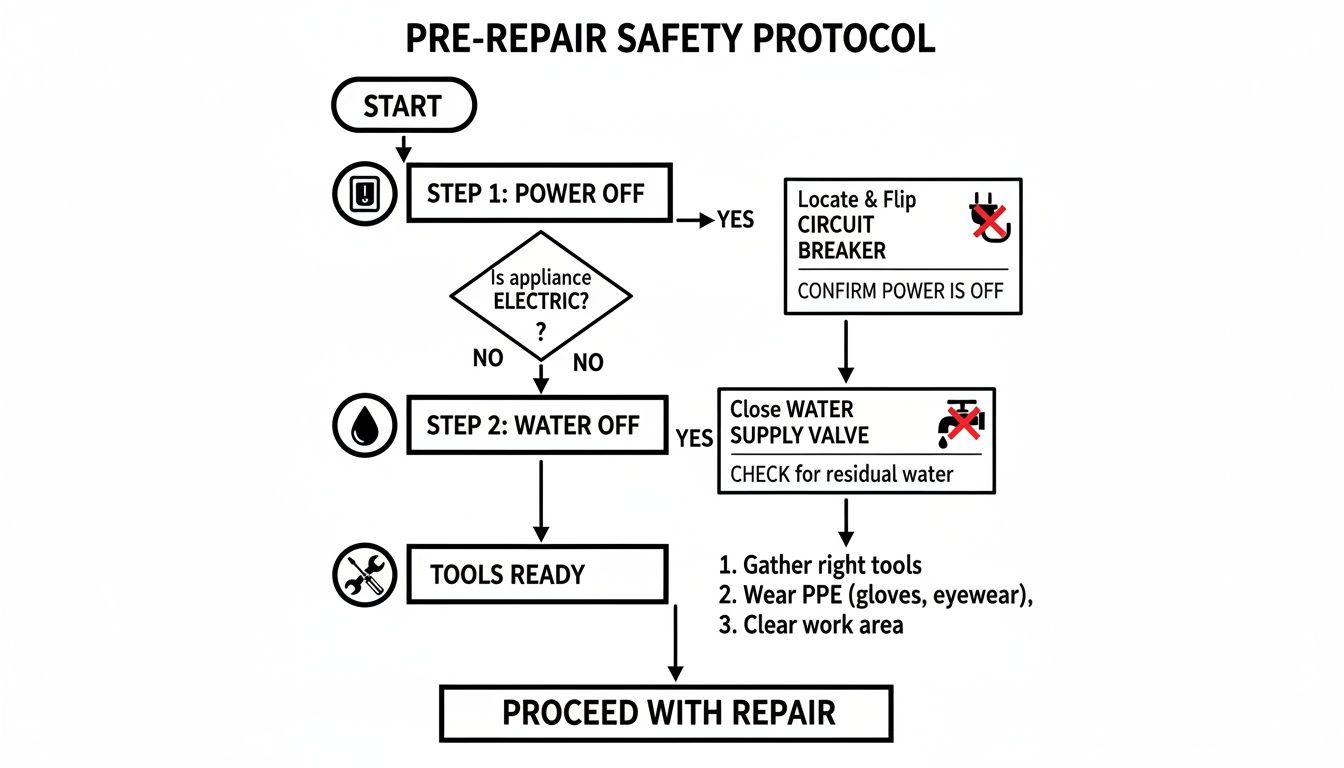
This simple flowchart is a great reminder: power off, water off, tools ready. Every single time. No exceptions.
Scenario 1: The Humidifier Is Completely Dead
This is the call we get most often, especially during that first real cold snap in West Michigan, usually from November through April. You crank up the humidistat, and… nothing. No click, no fan, no water. Just silence.
Check the Power Source: First thing's first, is the furnace actually running? A whole-house humidifier will only kick on when the furnace blower is moving air. If the furnace is running, grab your multimeter and check for 24 volts at the two low-voltage wires connecting to the humidifier. If you're getting no juice, the problem is likely upstream with the furnace control board or the wiring itself.
Test the Humidistat: If you've confirmed there's power getting to the unit, the humidistat itself might be the culprit. Turn that dial all the way to the highest setting. You should hear a distinct "click" as the solenoid valve engages. No click? The humidistat has probably failed and isn't sending the signal to turn on.
Inspect the Solenoid Valve: This little valve is the gatekeeper for the water. With the humidistat turned up and the furnace blower running, you should feel a slight vibration or hear a faint hum or click from the solenoid. If it's dead silent and you know it’s getting power (thanks to your multimeter), the valve itself has likely given up the ghost.
Scenario 2: The Humidifier Leaks Water
Nothing gets a homeowner’s attention faster than a puddle of water around the furnace. It’s alarming, but the fix is often surprisingly simple. A leak needs to be dealt with immediately to prevent serious damage to your furnace and home.
Your first move? Shut off the water supply at the saddle valve right away.
With the water off, check the drain line. It's that flexible tube coming off the bottom of the humidifier. It can get clogged with mineral gunk, especially with the hard water we have in places like Wyoming, Michigan. A clog forces water to back up and spill out. Just disconnect it and run some water through it to clear any blockage.
Next, take a look at the water panel (some call it an evaporator pad). If it isn't sitting just right in its housing, water can miss its intended path and dribble out the sides. Make sure it's seated properly and the cover is snapped on tight.
We see furnace humidifier breakdowns peak in the first two years of installation, accounting for 52% of all HVAC repair calls in northern states like Michigan. Industry stats show 68% of these repairs involve water distribution failures, usually from mineral buildup. A neglected humidifier can even shorten your furnace's life by 22%—a costly mistake. You can learn more from these humidifier market findings.
Scenario 3: The Unit Runs But The Air Is Still Dry
This one can be frustrating. You can hear the humidifier running, but your skin is still dry and you're getting zapped by static electricity every time you touch a doorknob. It's a classic sign that moisture just isn't getting into your ductwork, which almost always points to a water delivery issue.
Examine the Water Panel: This is the number one offender, hands down. A water panel that looks like a crusty, white science experiment can't absorb water. In areas with hard water like Jenison and Hudsonville, a panel can get completely clogged in just one season. If it's caked with mineral deposits, don't even try to clean it—just replace it.
Clean the Solenoid Valve Orifice: That tough West Michigan water is hard on small components. Over time, mineral scale can build up inside the solenoid valve and clog the tiny orifice where water passes through, reducing the flow to a mere trickle. You can carefully take the valve apart and use a pin or a small piece of wire to gently clear that opening.
Walking through these troubleshooting steps will help you solve the vast majority of humidifier problems. By tackling them in a logical order, you can pinpoint the issue and make the right repair with confidence.
DIY Repair vs Calling a Professional Cost And Time Estimate
So, you've diagnosed the problem. Now for the big question: should you fix it yourself or call in a pro? This table breaks down the typical costs, time, and skills needed for common repairs to help you decide.
| Repair Task | DIY Estimated Cost | DIY Time Commitment | When to Call a Pro |
|---|---|---|---|
| Replace Water Panel | $15 – $30 | 15 – 30 minutes | This is a classic DIY job. But if you’re unsure about the panel type or it's hard to access, a pro can do it during a tune-up. |
| Clean or Replace Drain Line | $5 – $10 (for a new tube) | 30 minutes | A very straightforward DIY task. Call a pro if the clog seems to be part of a larger plumbing issue. |
| Replace Humidistat | $40 – $100 | 1 – 2 hours | If you're comfortable with low-voltage wiring and using a multimeter, this is doable. If not, best to call us. |
| Replace Solenoid Valve | $30 – $75 | 1 – 2 hours | Involves both water and electrical connections. A great DIY project if you’re careful, but call a pro if you're hesitant about leaks or wiring. |
| Electrical Issues (No Power) | $10 – $20 (for wiring) | 2+ hours | If the problem is beyond a simple connection at the unit (e.g., furnace control board), call a licensed HVAC tech immediately. |
Deciding to DIY can save you money on parts and labor, especially for simple maintenance like changing a water panel. But for anything involving your furnace's main electrical board or complex wiring, the risk isn't worth the savings. When in doubt, give Platinum Heating & Cooling a call.
Keeping Your Humidifier Healthy with Proactive Maintenance
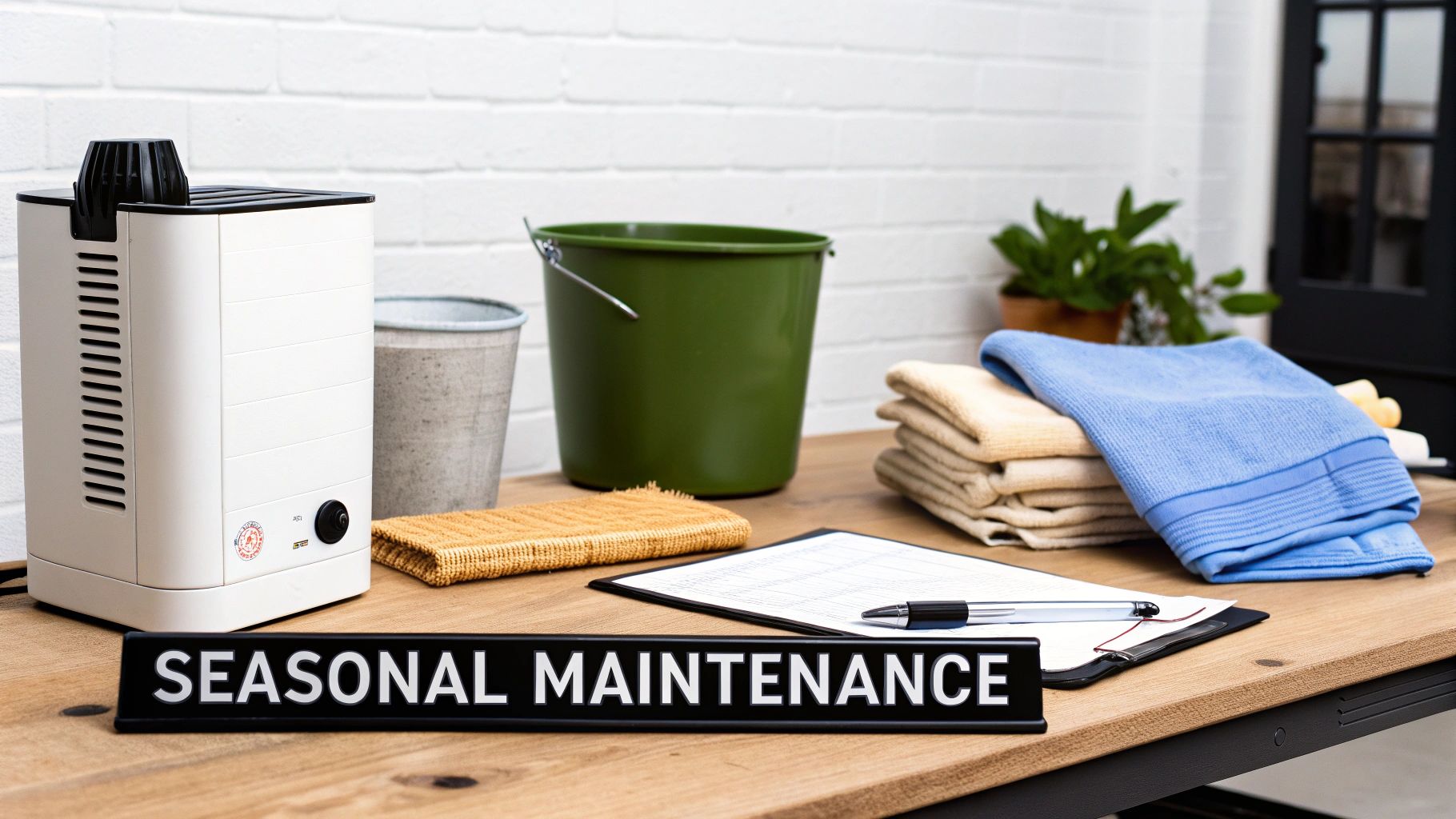
After going through all the common troubleshooting steps, you start to see a pattern. The absolute best way to repair furnace humidifier problems is to stop them from ever starting. A simple, proactive maintenance routine is your best friend here—it takes less than an hour a year and can sidestep the vast majority of issues we run into across West Michigan.
We're not talking about a major mechanical overhaul. This is all about building good habits that keep the system humming along. Just think of it as a quick seasonal checklist that protects your investment and makes sure your home stays comfortable when that cold, dry air settles in from November through April.
Your Seasonal Maintenance Checklist
This whole routine boils down to two key moments: getting things ready for winter and shutting it all down for the summer. If you can stick to this schedule, you’ll dramatically cut the odds of a frustrating mid-winter breakdown.
Fall Startup (Before You Turn the Heat On for the Season):
- Swap Out the Water Panel: Seriously, this is the most important thing you can do. In places like Hudsonville and Jenison where the water is hard, that crusty mineral buildup on the filter pad is public enemy number one for your humidifier. A fresh panel means water can evaporate efficiently.
- Open the Bypass Damper: Look for a handle on the ductwork connected to your humidifier. You'll want to flip it to the "Winter" or "Open" setting. This lets the air flow through the unit like it's supposed to.
- Turn the Water Back On: Find the small saddle valve on your water line. Slowly turn the handle until it’s parallel with the pipe. You’ve now got water flowing to the unit.
Spring Shutdown (When the Furnace Is Off for Good):
- Close the Bypass Damper: Flip that same handle back to the "Summer" or "Closed" position. No need for air to pass through it all summer.
- Shut Off the Water Supply: Turn the saddle valve handle clockwise until it stops. This prevents stagnant water from sitting in the lines and causing problems.
- Give the Unit a Quick Clean: Unplug the humidifier, pull out the old water panel, and wipe out any mineral scale left in the bottom basin. Doing this now keeps that gunk from hardening into a rock over the summer.
A routine check-up is your best defense against unexpected failures. Catching mineral buildup or a sticky valve in October is far less stressful than dealing with a broken unit during a January cold snap in Grandville.
This straightforward process keeps all the key parts clean and ready to go when you need them most.
When to Consider a Professional Tune-Up
While your own DIY maintenance covers the essentials, a professional tune-up gets into the nitty-gritty. It's a smart move every couple of years, or if you just aren't comfortable tackling these steps yourself. Our technicians in West Michigan, including Hudsonville, Jenison, Grandville, Walker, Standale, Allendale, & Wyoming michigan, can do a lot more than just a basic cleaning.
During a professional service call, a technician will check all the electrical connections, test the humidistat for accuracy, and professionally descale critical components like the tiny orifice inside the solenoid valve. For clients in our Platinum Maintenance Membership, this service is already baked into a comprehensive plan that keeps your entire HVAC system in peak condition, helping you avoid costly surprises and get more years out of your equipment.
Knowing When to Call an HVAC Professional
While rolling up your sleeves and tackling a humidifier problem can be rewarding, there are definitely times when making a phone call is the smartest move. It’s one thing to change a filter, but attempting complex repairs without proper training can turn a minor hiccup into a major, system-wide headache. Knowing your limits is key.
If you’ve gone through all the common troubleshooting steps and the humidifier is still on the fritz, that’s a good sign the problem runs deeper than a simple fix. Don't waste a whole weekend chasing an issue that might be way out of your league. Persistent problems usually point to something more complex happening inside your HVAC system.
Red Flags That Demand a Professional
Some symptoms are immediate red flags that mean you should stop what you're doing and call a pro.
If you even suspect an electrical issue coming from the furnace control board, back away. That board is the brain of your entire heating system, and a simple mistake there can be catastrophic—and expensive.
Another major warning sign is any significant water damage that's spreading beyond the humidifier unit itself. See moisture inside the main furnace cabinet or damp spots on the drywall nearby? That’s not a DIY fix. It needs an expert eye to find the source before it causes serious damage.
For Grand Rapids builders, new construction HVAC with humidifiers sees 27% post-install repair rates in the first year, often due to sensor faults or duct leaks that can be tricky to diagnose. Professional air quality testing accurately identifies 82% of these issues, leading to better indoor air and a 35% reduction in allergy flares. Discover more insights about the air humidifier market on gminsights.com.
The Value of an EPA-Certified Technician
When you call Platinum Heating & Cooling, you’re getting more than just a repair—you’re getting peace of mind. Our EPA-certified technicians have the right diagnostic tools and, more importantly, the field experience to trace problems back to their true source for a safe, lasting fix.
We're proud to serve homeowners all across West Michigan, from Hudsonville and Jenison to Grandville, Walker, Standale, Allendale, and Wyoming.
Whether it’s a tricky wiring problem, a hidden leak, or something else entirely, chances are we've seen it and fixed it before. We’re committed to our community, which is why we offer reliable 24/7 emergency service. We know these things never break at a convenient time. When you’re stuck, our team is ready to get your home's comfort and safety back on track, day or night. You can learn more about our commitment to excellent furnace service here.
Still Have Questions About Humidifier Repair?
Even after a fix, it's smart to have a few questions about your furnace humidifier and how to keep it running right. Our techs hear the same great questions from homeowners all over West Michigan, including Hudsonville, Jenison, Grandville, Walker, Standale, Allendale, & Wyoming michigan. Here are some quick, straight-to-the-point answers to the things we get asked most often.
Getting a handle on these details gives you more confidence in your system and helps you head off future problems. A little know-how goes a long way in staying comfortable during our long northern winters.
How Often Should I Replace My Humidifier Water Panel?
Here in the Grand Rapids area, we tell everyone the same thing: replace the water panel (sometimes called an evaporator pad) once a year. The best time to do it is in the fall, right before you kick the heat on for the season. Honestly, it's the single most important piece of maintenance you can do yourself.
That said, if your home has especially hard water—and many of our local towns do—you might find you need to swap it out twice a season. Once that panel gets clogged with white mineral scale, it just can't do its job. It's one of the biggest reasons we get service calls.
My Humidistat Is Set High, but My House Is Still Dry. Why?
Ugh, this one is frustrating, but we see it all the time. When we show up for a call like this, there are a few usual suspects we check first.
- Is the seasonal damper open? Look for a little lever on the ductwork near the humidifier. It needs to be flipped to "Winter" or "Open" so air can actually flow through the unit.
- How does that water panel look? Like we just mentioned, a crusty, mineral-caked panel is useless. Water can't evaporate from it, no matter how high you crank the humidistat.
- Is the solenoid valve clicking on? The small valve that lets water into the humidifier might be stuck or failed, starving the unit of water.
- Could the humidistat be bad? It's less common, but the control unit itself can fail and stop sending the signal to turn on.
Running through the troubleshooting steps we covered earlier in this guide will help you pinpoint exactly what's going on.
Should I Run My Furnace Humidifier in the Summer?
Definitely not. Your whole-house humidifier should only run during the heating season, which for us in West Michigan is roughly from November through April. Trying to run it in the warmer, stickier cooling months is just asking for trouble. You'll introduce way too much moisture into your home, which can lead to bigger problems like mold and mildew.
Make a simple shutdown routine for yourself at the end of winter. Just turn the humidistat dial to "Off," close the little saddle valve on the water supply line, and flip the bypass damper to "Summer" or "Closed." This puts your system away properly and prevents any surprises.
Is a Leaking Humidifier an Emergency?
Yes. Treat any water leak around your HVAC system as a serious issue. Even what looks like a tiny drip can cause a ton of expensive damage to your furnace's circuit boards and other electronics, not to mention your floors and ceilings.
Most leaks trace back to a clogged drain line, a crack in the plastic housing, or a loose water line connection. Your first move should always be to shut off the water supply to the unit immediately. If you can't find and fix the source of the leak right away, it's 100% the right call to get a professional out for an emergency visit. Our teams in West Michigan, including Hudsonville, Jenison, Grandville, Walker, Standale, Allendale, & Wyoming michigan, are always ready to roll.
When the DIY project gets to be too much or you just want the peace of mind of a professional diagnosis, Platinum Heating & Cooling is here to help. Our EPA-certified technicians provide expert furnace humidifier repair services across West Michigan. Schedule your service today at https://platinumheatingmi.com.