
When the summer heat settles over West Michigan from May to October, the first question on every homeowner's mind is, "What size AC unit do I need?" It’s a great question. You've probably heard the old rule of thumb—about 20 BTUs (British Thermal Units) per square foot—but leaning on that simple math alone is a shortcut you don't want to take.
Getting the size right is about so much more than a quick calculation. It's about making sure your home is a true escape from the heat without sending your energy bills through the roof. And when the cold winter months hit from November through April, the same principles apply to keeping your home warm and your heating bills in check.
Why AC Size Is More Than Just Square Footage
Picking a new air conditioner isn’t like buying a toaster. It’s a decision that will directly impact your family’s comfort and your budget for the next 10-15 years. The process of getting it just right is called "right-sizing," and honestly, it’s the single most important part of getting a new cooling system.
Think of it like buying a pair of running shoes. Too small, and they’ll pinch and hurt. Too big, and you’ll be sliding around, getting blisters. Either way, you’re not going to enjoy your run. An air conditioner works the same way. A unit that's too weak or too powerful for your home will cause a ton of problems that a simple square-footage guess completely ignores.
The Pitfalls of "Good Enough" Estimates
When a humid summer day hits Jenison or Grandville, an incorrectly sized AC shows its true colors fast. Homeowners usually fall into one of two traps: they either go too small to save a few bucks upfront, or they buy an oversized unit thinking, "bigger is always better."
Both are costly mistakes.
Undersized Units: These poor systems have to run nonstop, constantly fighting a losing battle on hot days in places like Allendale and Walker. They never quite get to the temperature you set, which means you’re stuck with high energy bills and a system that’s wearing itself out.
Oversized Units: This is the more common—and more deceptive—problem. A unit that’s too powerful will blast your home with cold air and shut off before it has a chance to pull the humidity out. This constant on-and-off cycle, called "short-cycling," leaves your home feeling cool but uncomfortably clammy and damp.
An improperly sized air conditioner doesn't just reduce comfort—it actively works against you, leading to higher energy consumption, premature equipment failure, and a stuffy indoor environment. Getting it right from the start is essential.
In fact, the right size AC can slash your energy bills by up to 30%. Here in West Michigan, where summer days can climb into the 90s with heavy humidity, an oversized unit that short-cycles will never get rid of that sticky feeling. At Platinum Heating & Cooling, we see this all the time in homes from Hudsonville to Wyoming, Michigan. Our main goal is to prevent these costly errors by making sure your system is a perfect match for your home. You can learn more about how proper sizing impacts AC efficiency and why it's so critical.
The Hidden Dangers of an Improperly Sized AC
When it comes to your home's comfort, figuring out "what size AC unit do I need?" is one of the most important questions you'll face. Too many homeowners in West Michigan, including Hudsonville, Jenison, Grandville, Walker, Standale, Allendale, & Wyoming, fall into two common traps, and both lead to a frustrating cycle of discomfort and sky-high utility bills.
Both mistakes—going too big or too small—have expensive consequences. Let's break down exactly what goes wrong, and you'll see why a professional, detailed assessment is the only way to guarantee a comfortable and efficient summer in your home.
The Problem with an Oversized AC Unit
You’d think bigger is better, but in the world of air conditioning, it's a recipe for trouble. An oversized unit is like a sprinter trying to run a marathon—it gives you a powerful burst for a short distance but has zero stamina for the long haul. This is a classic case of "short-cycling."
Here's what happens: the AC kicks on, blasts your home with frigid air, and hits the thermostat's target temperature so fast that it immediately shuts down. This aggressive on-off cycle repeats over and over, creating a whole mess of problems.
- Poor Humidity Control: Your air conditioner’s number one job, right after cooling, is pulling moisture out of the air. But because an oversized system doesn't run long enough, it never gets a chance to do its dehumidifying work. This leaves your home in Jenison or Grandville feeling cool but uncomfortably clammy and damp on a humid summer day.
- Premature Wear and Tear: The compressor is the heart of your AC, and constantly starting and stopping puts immense strain on it. All that extra wear and tear often leads to expensive repairs and can seriously shorten the system's lifespan.
- Energy Waste: Every time the system boots up, it draws a massive surge of electricity. When it's cycling on and off all day, it’s constantly in this high-energy startup mode, wasting power and driving your bills through the roof.
The Struggle of an Undersized AC Unit
On the flip side, an undersized air conditioner is always playing catch-up. It's like asking a small sedan to tow a large boat—it's going to try its best, but it just wasn't built for that kind of load. On a hot afternoon in Walker or Standale, this unit will run nonstop and still never reach the cool, comfortable temperature you want.
This constant battle leads to its own set of damaging issues.
An undersized AC unit is locked in a losing battle against the summer heat. It runs continuously, straining every component, yet fails to deliver the comfort you paid for, resulting in maximum energy costs for minimal cooling.
This constant struggle means you're paying top dollar for electricity while your home stays uncomfortably warm. That relentless workload also puts a ton of strain on the entire system, from the fan motor to the compressor, leading to more frequent breakdowns and an early replacement.
At Platinum Heating & Cooling, we prevent these exact problems for homeowners across Allendale and Wyoming, Michigan. Our approach isn't about guesswork or simple square footage rules. We use precise, industry-standard calculations to make sure your new air conditioner is perfectly matched to your home's unique cooling needs, protecting your investment and guaranteeing your comfort for years to come.
Factors That Influence Your Perfect AC Size
Moving past the simple square-footage rules is where we really dial in the right AC size for your home. Your house is unique, and its specific quirks play a huge role in how much cooling power it actually needs. This is where a professional approach, like a Manual J load calculation, is absolutely essential.
This detailed analysis looks at every single variable affecting how your home gains and loses heat. Think of it like a custom-tailored suit versus one you grab off the rack—the custom fit is always going to be more comfortable and perform better because it was made just for you. Let's break down the key factors an expert from Platinum Heating & Cooling will look at to find that perfect fit.
Your Home's Thermal Envelope
The "thermal envelope" is just a way of describing everything that separates your comfortable living space from the outside world. This includes your insulation, windows, and even which direction your house faces. Each one of these can drastically change your cooling needs during the warmer months, and your heating needs in the winter months of November through April.
Insulation Levels: Good insulation in your attic and walls is like a high-quality thermos—it keeps the cool air in and the summer heat out. An under-insulated home in Grandville will demand a much more powerful AC than a well-insulated one of the exact same size.
Windows and Sun Exposure: Those big, beautiful, single-pane windows, especially if they face south or west, are like giant magnifying glasses. They let in a ton of solar heat. A home in Jenison with lots of south-facing windows will have a much higher cooling load than a shaded home with modern, energy-efficient windows.
Air Leaks and Ductwork: You’d be shocked at how much cool air can escape through tiny gaps around windows, doors, and pipes. On top of that, leaky or poorly insulated ductwork in an older Standale home can lose up to 20-30% of its cooled air before it even gets to your vents. That forces your AC to work way harder than it should.
A home's unique mix of insulation, windows, and air leaks dictates its real cooling demand far more than square footage ever could. A professional assessment finds these hidden heat sources to make sure your AC is sized for your actual needs, not just a guess.
The Impact of Local Climate and Home Layout
Beyond the structure itself, West Michigan’s specific climate and your home's design create their own cooling challenges.
The infographic below shows what happens with the two biggest sizing mistakes—oversizing and undersizing—and why both are a problem.
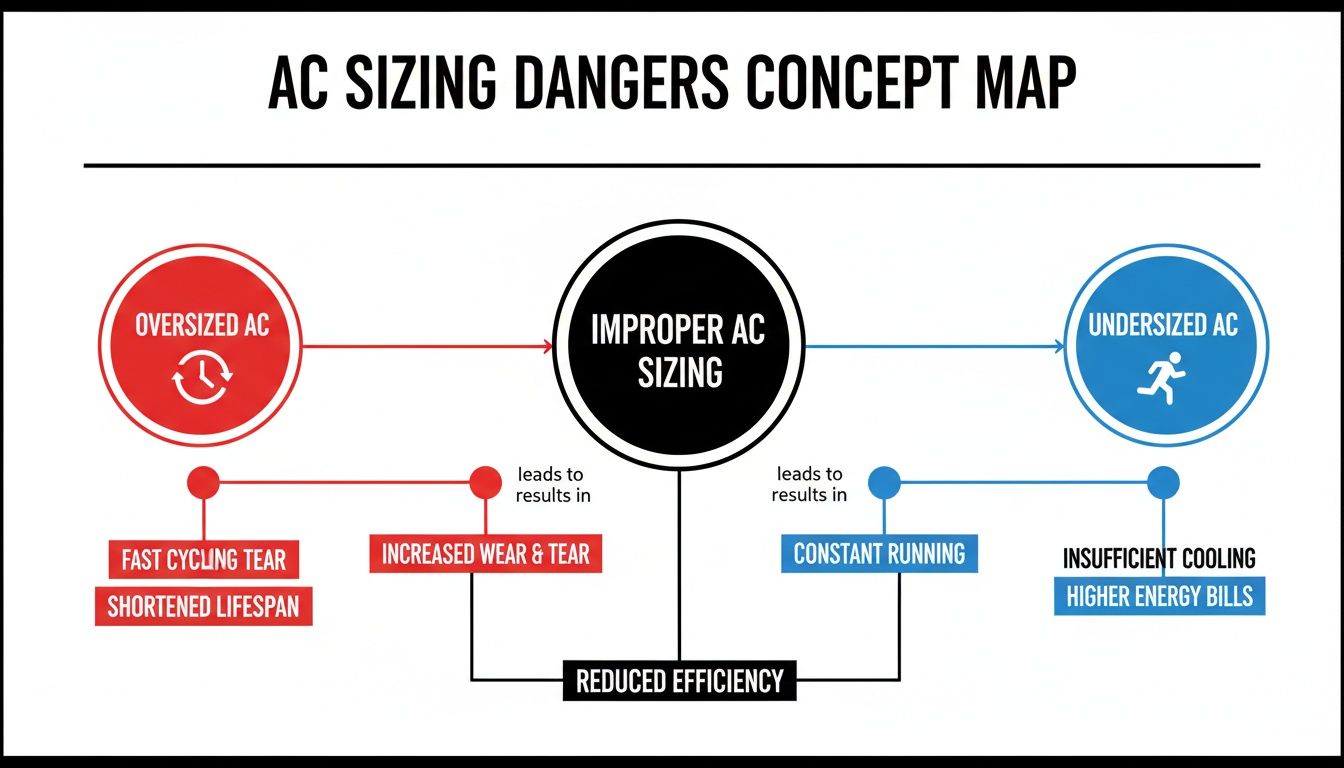
As you can see, an oversized unit cycles on and off too fast, while an undersized one never stops running. Finding that "just right" balance is everything.
Our local climate is a huge player. The humid summers across West Michigan mean your air conditioner has to do two jobs: lower the temperature and pull moisture from the air. A system sized for a dry climate would be a disaster here, leaving your home feeling clammy and damp even if the thermostat says it's cool. An expert takes this regional humidity into account to pick a unit that can handle both jobs well. For more tips on keeping your system running at its best, check out our guide on how to clean your AC condenser unit.
Internal Heat Sources and Lifestyle
Finally, what happens inside your home generates a surprising amount of heat. A proper Manual J calculation considers these "internal loads" to get the full picture.
Occupancy: Every person in your home gives off body heat, roughly the same as a 100-watt light bulb. A family of five has a very different cooling need than a couple living in the same house.
Appliances and Lighting: Ovens, dishwashers, dryers, computers, and especially older incandescent light bulbs all produce heat. A professional calculation factors in the heat generated by your daily life.
Ceiling Height: A home in Allendale with vaulted ceilings has a much larger volume of air to cool than one with standard 8-foot ceilings, even if the square footage is identical. All that extra air requires more cooling power.
Climate change is also shifting the goalposts. Research shows that U.S. cooling degree days have jumped by 15% since 1970, meaning our summers are demanding more from our ACs. For example, a modern 1,800 sq ft two-story home in Wyoming, Michigan with a lot of sun exposure might need a 3.5-ton (42,000 BTU) unit to stay truly comfortable. That's why getting a professional on-site assessment is more important today than it has ever been.
Decoding BTUs, Tons, and the Manual J Calculation

When you start looking into "what size AC unit do I need," you'll quickly hit a wall of technical jargon. Words like BTUs, tons, and Manual J can feel like a foreign language, but they're the key to making a smart, confident decision for your home. Let's break down exactly what they mean and, more importantly, why they matter so much.
Think of BTUs (British Thermal Units) as calories, but for your house. A calorie is a unit of energy for your body, and a BTU is a unit of heat energy. Specifically, one BTU is the energy needed to raise one pound of water's temperature by one degree Fahrenheit. An AC's BTU rating tells you how much heat it can pull out of your home in one hour.
Then you'll hear HVAC pros talk about "tons" of cooling. This has nothing to do with how much the unit weighs. One ton of cooling is simply equal to 12,000 BTUs per hour. The name is a cool bit of history, a holdover from when ice was used for cooling, representing the power of melting one ton of ice over 24 hours.
The Gold Standard: The Manual J Calculation
Knowing what BTUs and tons are is a great start, but it doesn't answer the main question. To do that, you have to know precisely how many BTUs your specific home needs to stay cool. This is where the Manual J load calculation comes in.
Developed by the Air Conditioning Contractors of America (ACCA), the Manual J calculation is the industry's undisputed best practice for sizing an HVAC system. It isn't a ballpark figure or a guess—it's a scientific analysis. Think of it as a complete energy audit focused squarely on your home's cooling requirements.
A proper Manual J calculation moves way beyond simple square footage rules. It's the only method that accounts for your home's unique thermal fingerprint. An HVAC professional will meticulously measure and factor in all the variables we covered earlier, such as:
- Local climate data for West Michigan, including average summer heat and humidity levels.
- The R-value of your insulation in the walls and attic.
- The number, size, type, and direction of every window.
- Air leakage from doors, windows, and other gaps.
- Heat generated by the people and appliances inside your home.
This deep-dive approach ensures the AC size we recommend is based on hard data, not just a hunch.
Why Guesswork Fails in West Michigan
The history of sizing ACs shows just how far we've come. Back in the 1950s, it was often just a wild guess based on room size. It wasn't until the Arab Oil Crisis of the 1970s that the industry got serious about precision, leading to the development of the BTU standard and the Manual J method.
Here in the Grand Rapids area, where we can get over 140 humid days a year, this precision is non-negotiable. A standard 1,500 sq ft ranch might seem to need a 2.5-ton unit based on a simple chart. But if that same house has a vaulted ceiling and a big west-facing window, its actual need could easily jump to 3.5 tons.
This is why those free online calculators so often miss the mark. They can't see the big picture. They don't know about the poor insulation in your older Jenison home or the sun that beats down on your Grandville living room all afternoon.
Let's look at the difference more closely.
Rule of Thumb vs. Manual J Calculation
| Factor | Square Footage Rule of Thumb | Professional Manual J Calculation |
|---|---|---|
| Foundation | A rough estimate based on a single variable (area). | A detailed scientific analysis of the entire home. |
| Windows | Ignored. | Considers size, type, orientation, and shading. |
| Insulation | Not factored in. | Measures the R-value of walls, ceilings, and floors. |
| Air Leakage | Not accounted for. | Calculates heat gain from drafts around doors and windows. |
| Occupancy | Assumes a generic number of occupants. | Considers the actual number of people living in the home. |
| Local Climate | Uses a broad regional guess. | Incorporates specific local temperature and humidity data. |
| Result | A one-size-fits-all guess that's often wrong. | A precise cooling load number tailored to your home. |
At Platinum Heating & Cooling, we use this precise, data-driven approach to cut energy use by up to 25% compared to older, outdated sizing methods. By performing a real Manual J calculation, our technicians ensure clients from Wyoming to Allendale, Michigan get a system that's perfectly matched to their needs, guaranteeing comfort and efficiency for years.
Learn more about our approach to central air and heating systems.
Your Next Steps for a Perfectly Cooled Home
Alright, now you know that picking the right AC size is about way more than just square footage. It's time to put that knowledge to work. You don't need to be an HVAC pro for this next part, but getting a clear picture of your home’s situation will make the conversation with a professional a whole lot more productive.
It all starts with a simple walk-around you can do yourself. By spending a few minutes playing detective in your own home, you'll gather key clues that go directly into a professional load calculation. This isn't just busy work; it's about empowering you to understand exactly why a certain AC is recommended, so you can make a decision you feel great about.
Simple DIY Home Checks to Perform Today
Before you pick up the phone, grab a notepad and take a tour of your home. You're looking for anything that might be letting cool air out or inviting unwanted heat in.
- Look for Air Leaks: Get up close to your windows and exterior doors. Feel for drafts? See any slivers of daylight around the frame? Those tiny gaps can add up to a ton of wasted energy.
- Check Your Attic Insulation: If you can safely pop your head into the attic, take a look around. Is the insulation patchy or uneven? A good rule of thumb is that it should be deep enough to cover the floor joists. A poorly insulated attic is a massive heat magnet during a hot West Michigan summer.
- Identify Hot Spots: Notice which rooms feel like a sauna on a sunny afternoon. That sun-blasted living room in Grandville or a west-facing bedroom in Jenison is going to need more cooling power than the rest of the house.
- Note Your Windows: Do a quick count of your windows and which direction they face. A home with a lot of big, old single-pane windows facing south or west is going to have a much tougher time staying cool.
Doing these quick checks doesn’t take the place of a professional evaluation, but it makes that conversation so much better. You’ll have real observations to share, helping your technician zero in on the perfect solution for your home's unique quirks.
Why an On-Site Evaluation Is Non-Negotiable
After you've done your homework, the last and most important step is to get a professional on-site evaluation. An online calculator or a guess over the phone simply can't see the reality of your property. An expert technician needs to physically be there to measure, inspect, and plug all that real-world data into an accurate Manual J load calculation.
This visit is the only way to be 100% sure your new system is sized correctly. A certified technician from Platinum Heating & Cooling will verify your insulation levels, measure your windows, check the condition of your ductwork, and factor in our unique West Michigan climate. This detailed process gets rid of the guesswork, protecting you from the costly mistakes of an oversized or undersized system and ensuring your comfort for years.
For homeowners in West Michigan, including Hudsonville, Jenison, Grandville, Walker, Standale, Allendale, & Wyoming, Michigan, a perfect installation is just as critical as the right unit. To get your home ready for the summer cooling season, learn more about our professional air conditioning installation services and schedule your free, no-obligation assessment with our certified technicians today.
Common Questions About Sizing Your AC Unit
Even when you think you have all the info, a few questions always seem to pop up when it's time to pick an AC unit size. Here are the straightforward answers to the questions we hear the most from homeowners all over West Michigan.
Can I Just Replace My Old AC with the Same Size Unit?
It's tempting to take that shortcut, but it's usually not a good idea. For starters, your original unit might have been the wrong size from day one—it's a surprisingly common problem.
Plus, any upgrades you've made over the years, like new windows, better insulation, or even finishing the basement, will absolutely change how much cooling your home actually needs. It’s always best to get a fresh, professional load calculation to make sure your new system is a perfect fit for your home as it stands today.
Does a Two-Story Home Need a Bigger AC?
Often, the answer is yes. Two-story homes have their own unique cooling challenges. Heat naturally rises, which can turn your upstairs into a sauna on a hot summer afternoon, making it much tougher to cool. The way the sun hits different parts of the house at different times also adds to the heat load.
For many larger homes in West Michigan, from Grandville to Allendale, a zoned HVAC system is the ideal solution. By using multiple thermostats, you get independent temperature control for each floor, which means maximum comfort and better efficiency all around.
One of the biggest mistakes we see is homeowners thinking a bigger AC will cool the house faster. An oversized unit actually does the opposite. It short-cycles, shutting off before it can properly remove humidity, leaving you with a clammy house, higher wear-and-tear, and a shorter system lifespan.
How Does a SEER2 Rating Affect AC Size?
This is a great question because it highlights two very different—but equally important—metrics. SEER2 and AC size measure completely different things.
Think of it like a car. The AC's size (in BTUs or tons) is its horsepower—the raw cooling power. The SEER2 rating is its fuel efficiency, or miles per gallon.
A higher SEER2 rating just means the unit uses less electricity to do its job. For the best of both worlds, you need an AC that's sized correctly for your home and has a high SEER2 rating. That powerful combination delivers ultimate comfort at the lowest possible running cost.
Ready to dial in the perfect AC size for your home in Hudsonville, Jenison, Grandville, Walker, Standale, Allendale, & Wyoming, Michigan? The certified experts at Platinum Heating & Cooling will perform a detailed load calculation to ensure your new system is a perfect fit. Schedule your free, no-obligation assessment today!