
When you're weighing a tankless water heater vs a regular water heater, the conversation really boils down to paying more now or paying more later. Tankless models are fantastic for busy families because they deliver endless hot water and rack up serious energy savings over time. On the flip side, traditional tank heaters have a much friendlier price tag upfront, which can be the deciding factor for homeowners watching their budget.
Choosing Your Next Water Heater In West Michigan
Picking a new water heater is a big decision for any homeowner here in West Michigan, including Hudsonville, Jenison, Grandville, Walker, Standale, Allendale, & Wyoming, Michigan. It's an investment that directly hits your daily comfort, your monthly utility bills, and what you’ll spend on maintenance down the road. The two main players—tankless (on-demand) and regular (storage tank) heaters—work in completely different ways, and each has its own set of perks depending on your family's needs.
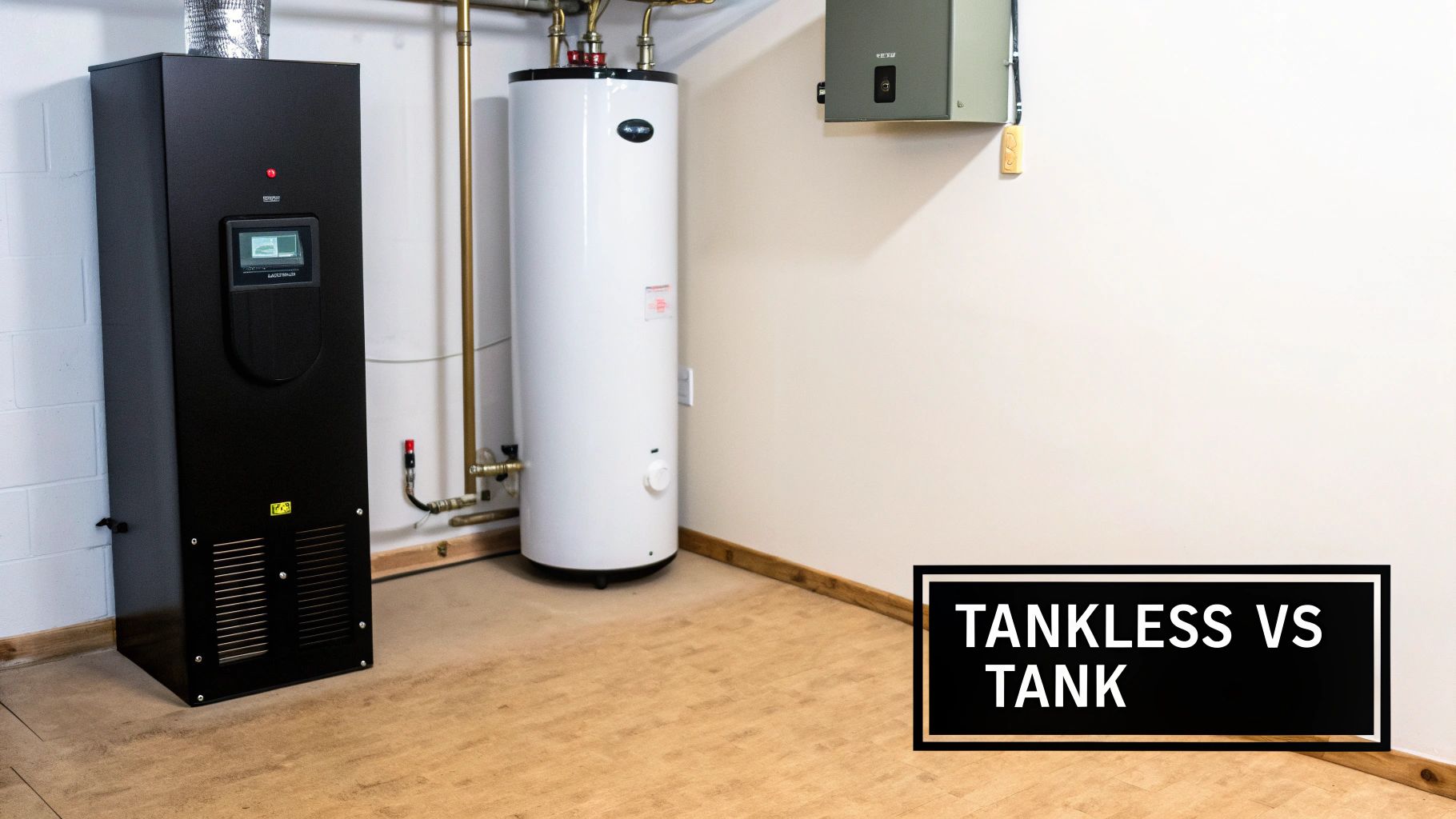
A regular water heater is basically a big insulated thermos, keeping 40 to 80 gallons of water hot and ready to go. The downside? It's always using energy to keep that water heated, a problem called standby heat loss. This can be a real energy hog, especially during our cold northern winter months from November through April when your furnace is already working overtime. In the other months, while your AC is running, this constant heat source can even add to your cooling load.
A tankless water heater, however, heats water instantly, right when you need it. The moment you turn on a hot water tap, cold water zips through the unit, and a powerful gas burner or electric element heats it on the spot. This completely gets rid of standby heat loss, making it a much more efficient choice.
Understanding The Core Differences
For homeowners in places like Hudsonville, Jenison, and Grandville, getting these differences is crucial. The constant demand for hot water during our chilly northern winter months from November through April makes efficiency a huge deal. A tankless system can keep the hot water flowing for back-to-back showers after a day out in the snow, while a traditional tank could leave the last person in the cold, waiting for the tank to reheat.
The single biggest difference is how they handle energy. A tank heater constantly spends energy keeping water hot, while a tankless unit only works when you need it, potentially saving you up to 34% on water heating costs.
This guide is here to help residents across West Michigan—from Walker and Standale to Allendale and Wyoming—make the right call by laying out a clear, side-by-side comparison of these two systems.
At A Glance Tankless Vs Tank Water Heaters
To make things simple, here’s a quick rundown of the core differences between tankless and traditional water heaters for your home. This table breaks down the key decision factors to help you see which one might be a better fit.
| Decision Factor | Tankless Water Heater | Regular (Storage Tank) Water Heater |
|---|---|---|
| Upfront Cost | Higher initial investment | Lower initial investment |
| Operating Cost | Lower due to high energy efficiency | Higher due to standby heat loss |
| Hot Water Supply | Endless and on-demand | Limited to tank capacity |
| Lifespan | 20+ years | 8-12 years |
| Space Required | Compact, wall-mounted design | Large, bulky footprint |
| Energy Efficiency | 24-34% more efficient | Less efficient |
| Maintenance | Periodic descaling needed | Annual flushing recommended |
Ultimately, the table shows a clear trade-off: tankless heaters cost more upfront but save you money and offer convenience in the long run, while tank heaters are the go-to for a lower initial purchase price.
Understanding Upfront Costs And Installation Realities
When you’re weighing a tankless water heater against a regular one, the first thing most people look at is the price tag. But the sticker price is just the beginning. The real cost comes from the unit itself, the labor to install it, and any surprise modifications your home’s plumbing or electrical system might need. This is where the two systems really start to look different, especially for homes here in West Michigan.
A standard storage tank water heater almost always has a lower upfront cost. For most homes in places like Jenison or Grandville, swapping out an old tank for a new one is a pretty straightforward job. The plumbing and venting are typically already in place, which keeps labor time—and installation costs—down to a minimum.
Breaking Down The Investment For Each System
The financial picture for tankless water heaters is a bit more involved. The unit itself costs more, sure, but the installation is often where the real work—and expense—comes in. This is something every homeowner needs to think about before making the switch.
For instance, many older homes in Wyoming or Allendale, Michigan weren't built with the infrastructure to handle a modern tankless unit. These powerful on-demand systems need a lot more energy to heat water instantly, and that can mean some serious upgrades are in order.
A key factor influencing the final cost of a tankless installation is your home's existing utility setup. Upgrading gas lines for higher BTUs, installing new dedicated electrical circuits, or rerouting complex venting systems can add hundreds, or even thousands, to the project total.
This is exactly why getting a professional assessment is so important. An experienced tech can spot these needs from the get-go, giving you a clear and accurate quote with no hidden surprises. To get a better feel for the details, take a look at our guide on the ins and outs of a professional tankless water heater installation service.
Key Installation Cost Factors
The final bill for either system is going to depend on a few variables. Here in West Michigan, these are the most common things that will move the needle on your installation cost:
- Unit Price: High-quality tankless models can easily cost two to three times more than a traditional tank heater.
- Labor Complexity: A simple tank swap might only take a few hours. A tankless retrofit, on the other hand, could be a full day's work, especially if major modifications are needed.
- Utility Upgrades: High-demand gas tankless units often need a larger-diameter gas line to work right. Electric models might require a brand-new, dedicated circuit and a higher-amperage breaker, adding to the expense.
- Venting Requirements: High-efficiency tankless heaters need special venting, usually PVC pipes run through a side wall, which is a much more involved job than venting a traditional tank.
Comparing Typical Cost Ranges In West Michigan
To put all this in perspective, let’s look at some typical installed cost ranges you might see for homes around the Grand Rapids area. Keep in mind, these are just estimates—your home and the specifics of the job will determine the final price.
| Water Heater Type | Unit Cost Estimate | Installation Cost Estimate | Total Upfront Investment |
|---|---|---|---|
| Regular (Storage Tank) | $500 – $1,200 | $400 – $1,000 | $900 – $2,200 |
| Tankless (On-Demand) | $1,000 – $2,500 | $1,200 – $3,000+ | $2,200 – $5,500+ |
As you can see, the upfront financial commitment for a tankless water heater is quite a bit higher. But it’s crucial to see this as an investment, not just an expense. For many families in Standale and Walker, the long-term energy savings, longer lifespan, and the luxury of endless hot water more than justify the initial cost—especially during our long, cold northern winter months from November through April when hot water demand is at its peak.
Analyzing Long-Term Energy Efficiency And Savings
Beyond the sticker price, the real cost of a water heater shows up on your monthly utility bills. When you put a tankless water heater up against a regular one, the long-term energy savings make a powerful case for going tankless. This is a big deal here in West Michigan, where heating costs chew up a major part of any household budget, especially during our cold northern winter months from November through April.
A traditional storage tank heater is basically a giant kettle. It’s always burning fuel or using electricity to keep a big tank of hot water, 24/7. This constant energy draw is called standby heat loss. Even when no one is home in your Hudsonville or Jenison house, that heater is working—and wasting energy—just to keep water ready.
On-demand systems completely flip that script. By heating water only when you turn on a faucet, they eliminate standby heat loss entirely. This isn't just a small efficiency tweak; it’s a fundamental design difference that leads to real savings over the life of the unit.
Quantifying The Energy Savings
The efficiency you get from a tankless model isn't just on paper. Did you know that tankless water heaters can cut your energy bills by up to 34% compared to traditional tank models? For homes using 41 gallons or less of hot water a day—which is most households in West Michigan—tankless units are 24% to 34% more energy efficient.
That's a huge difference, especially when you consider that water heating can account for nearly 18% of your home's total energy budget. While a tank heater reheats its stored water around the clock, a tankless unit only fires up when you need it, instantly heating water as it flows through at a rate of 2-5 gallons per minute. You can dig into these efficiency ratings on the U.S. Department of Energy's website.
This efficiency means lower operating costs, plain and simple. For a typical family in Walker or Standale, that drop in the monthly gas or electric bill can be substantial, helping to pay back the higher upfront installation cost over time.
The core financial benefit of a tankless system is its ability to transform a recurring energy expense into a long-term investment. By eliminating standby heat loss, you are actively cutting down on wasted energy month after month.
This kind of consistent saving is why a lot of people see the upgrade to tankless not just as a nice-to-have, but as a smart financial move that pays for itself. The energy savings are similar to what you see in modern HVAC systems, like we talked about in our article on what a heat pump is and how it saves money.
Calculating Your Return On Investment
The Return on Investment (ROI) for a tankless water heater is the point where your energy savings have officially paid off the higher initial price. While the exact timeline depends on how much hot water your family uses and local utility rates, the math is pretty simple for most West Michigan families.
Let’s run the numbers for a hypothetical family in Grandville who spends about $50 a month to heat water with a traditional tank heater.
- Traditional Tank: Monthly cost = $50
- Tankless Unit (with 30% savings): Monthly cost = $35
- Monthly Savings: $15
- Annual Savings: $180
If the upfront cost difference between the two systems was $1,800, your payback period would be 10 years ($1,800 / $180 per year). Since a tankless unit can last 20 years or more, that means you could enjoy a full decade or more of pure savings after the unit has paid for itself.
For larger families with higher hot water demands, that payback period is often even shorter. This is what makes the financial case for a tankless system so strong, especially if you're planning to stay in your home for the long haul.
Comparing Lifespan, Maintenance, And Durability
When you’re putting serious money into your home, you want it to last. In the tankless vs. regular water heater debate, how long it lives and how much work it needs are huge factors. It’s not just about today; it’s about how reliably it’ll serve your family for years to come.
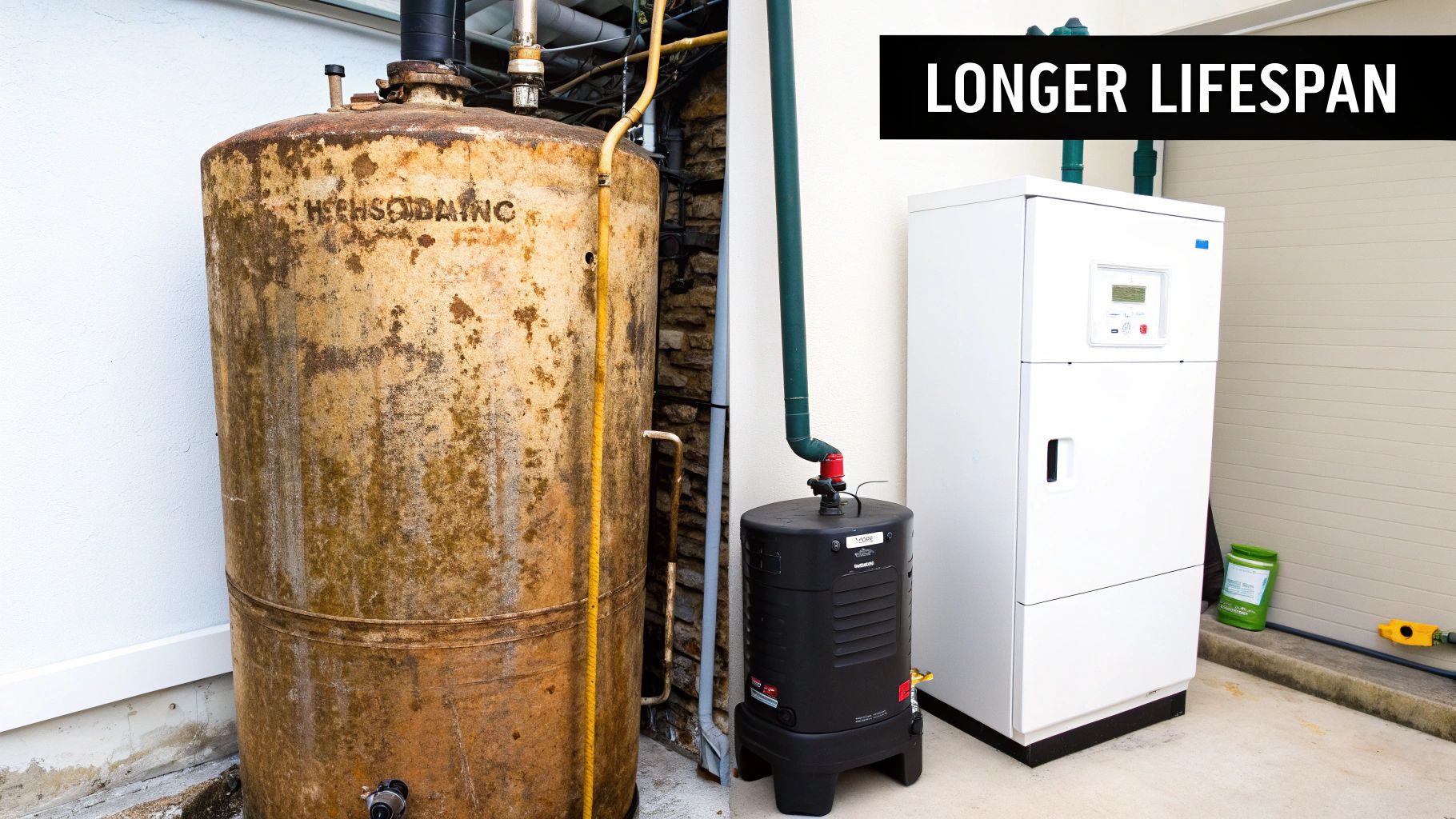
A classic storage tank water heater will typically give you about 8 to 12 years of service. The reason for its shorter life is baked right into its design—it’s always holding dozens of gallons of water. This creates the perfect storm for rust and sediment buildup. Eventually, corrosion eats away at the tank until it fails, often leaving you with a mess and a big replacement bill.
Tankless water heaters, on the other hand, are built for the long haul. Since they don’t store water, they completely sidestep the corrosion and gunk that kills traditional tanks. A well-cared-for tankless unit can easily last 20 years or more, often doubling the lifespan of a tank-style heater.
Lifespan Expectations For Your Home
That difference in longevity is a game-changer. Tankless heaters can run for 15-20 years, even 20+, while standard tanks are usually done in 8-12 years. This is a big reason why tankless is catching on so fast with West Michigan homeowners who want durable, space-saving options. It simply means fewer replacements over the decades.
A new tank might run $800-$1,500, but you'll likely be buying another one in about a decade. A tankless unit costs more upfront, maybe $2,500-$5,000, but it lasts twice as long and saves you money on energy bills along the way.
Understanding Maintenance Needs In West Michigan
Getting the maximum lifespan from any water heater comes down to proper maintenance. But the upkeep for each type is pretty different, especially with the hard water we deal with in places like Hudsonville, Jenison, and Grandville, Michigan.
Regular Tank Heater Maintenance:
- Annual Flushing: You need to drain and flush the tank at least once a year. This clears out mineral deposits that hurt efficiency and speed up corrosion.
- Anode Rod Check: The anode rod is a "sacrificial" part that draws corrosion away from the tank liner. It needs to be checked every few years and replaced when it gets worn down.
Tankless Water Heater Maintenance:
- Periodic Descaling: Hard water minerals can clog up the heat exchanger in a tankless unit. A descaling flush with a special solution is usually needed every year or two to keep it running right.
For West Michigan homeowners, hard water is just a fact of life. The descaling that a tankless heater needs is a direct solution to this problem, protecting the sensitive components so they last. If you ignore it, you’re asking for trouble.
The maintenance routines are different, but both are critical. If you don't flush a tank heater, its efficiency will slowly drop until it dies an early death. Forgetting to descale a tankless unit can cause it to stop working effectively long before its time. You can always count on professional help to handle these tasks right; learn more on our dedicated water heater service page.
At the end of the day, the durability of a tankless water heater is one of its biggest advantages. While it has its own maintenance needs, its design fundamentally avoids the wear and tear that sends traditional tanks to the scrapyard after just a decade. For homeowners in Allendale, Walker, Michigan, and across the region, that means fewer replacements, less hassle, and more peace of mind.
How Each System Delivers Hot Water to Your Faucet
When you're deciding between a tankless water heater and a regular one, the biggest difference you'll feel every single day is how they actually deliver hot water. This isn't just a technical detail; it directly impacts your morning routine, your chores, and your family's overall comfort. The two technologies are measured in completely different ways, and understanding that is key.
A traditional storage tank heater has what's called a First Hour Rating (FHR). This tells you exactly how many gallons of hot water it can push out in one hour, assuming it starts with a full, heated tank. It's a decent benchmark, but it also reveals the system's biggest weakness—once that stored water is gone, you're stuck waiting for it to reheat.
On the other hand, a tankless water heater is measured by its Flow Rate, in gallons per minute (GPM). This number shows you how much hot water the unit can make on the spot. As long as you don't use more water than its GPM rating at one time, you will never run out of hot water. It’s endless.
A Real-World Morning in a West Michigan Home
Let's paint a picture of a typical morning rush in a Hudsonville home. Someone's in the shower (2.0 GPM), the dishwasher is running (1.5 GPM), and a hot load of laundry is going at the same time (2.0 GPM). Add that all up, and you're demanding 5.5 GPM from your water heater.
A tankless water heater, properly sized for West Michigan's cold groundwater, won't even break a sweat. It can easily meet that demand, heating water for all three uses simultaneously. The person in the shower won't feel a single temperature drop. The hot water just keeps coming.
Now, imagine that same scenario with a standard 50-gallon tank heater. It might keep up for a few minutes, but that tank is going to drain fast. Once it's empty, the heater goes into "recovery time," desperately trying to heat the next batch of cold water. For you, this means the shower suddenly goes from hot to lukewarm, and the morning routine comes to a screeching halt.
Here's the bottom line: a tank heater gives you a limited supply of stored hot water. A tankless heater provides a continuous, unending stream. For busy families—especially during our chilly northern winter months from November through April—that unlimited supply is an absolute game-changer.
Understanding Potential Performance Hiccups
While tankless systems are phenomenal, they aren't perfect. You might have heard about the "cold water sandwich" effect. This can happen if you use hot water for a few seconds, turn it off, then quickly turn it back on. The unit shuts down after the first use, leaving a little slug of cold water in the pipes that gets delivered between two bursts of hot water.
Frankly, this is mostly an issue with older models. Modern tankless units have pretty much engineered this problem out of existence with features like tiny buffer tanks and smart recirculation technology. More importantly, a professional installation from certified technicians is your best defense. Experts working in Jenison, Grandville, and Wyoming, Michigan know exactly how to configure a system to eliminate these minor quirks for good.
Ultimately, the right choice boils down to what your family truly needs. If you're tired of scheduling showers or constantly running out of hot water, the endless supply from a tankless system offers a level of comfort and convenience that a tank just can't match. For a family in Allendale or Walker, Michigan, being able to run multiple hot water appliances without a second thought makes daily life that much easier.
Making The Right Choice For Your Property
So, how do you decide between a tankless water heater and a regular one? It really boils down to your property’s unique needs and what you're looking for long-term. The best choice for a family in Hudsonville might not be the right fit for a multi-unit property over in Grandville. Let's break it down to make the decision clearer.
For many homeowners in Jenison and Allendale, the choice is a classic tug-of-war between upfront cost and long-term value. If your budget is the biggest factor and your family has a pretty standard hot water routine, a modern, energy-efficient storage tank heater is still a solid, reliable option. It gets the job done at a much lower initial investment.
However, if you're planning on staying in your home for the long haul, a tankless water heater often makes more financial sense. Its incredible energy efficiency, especially during our cold northern winter months from November through April, leads to consistent savings on your utility bills that chip away at the higher installation cost. Plus, the endless hot water is a game-changer for busy households.
This simple guide can help you visualize the choice based on what matters most to you.
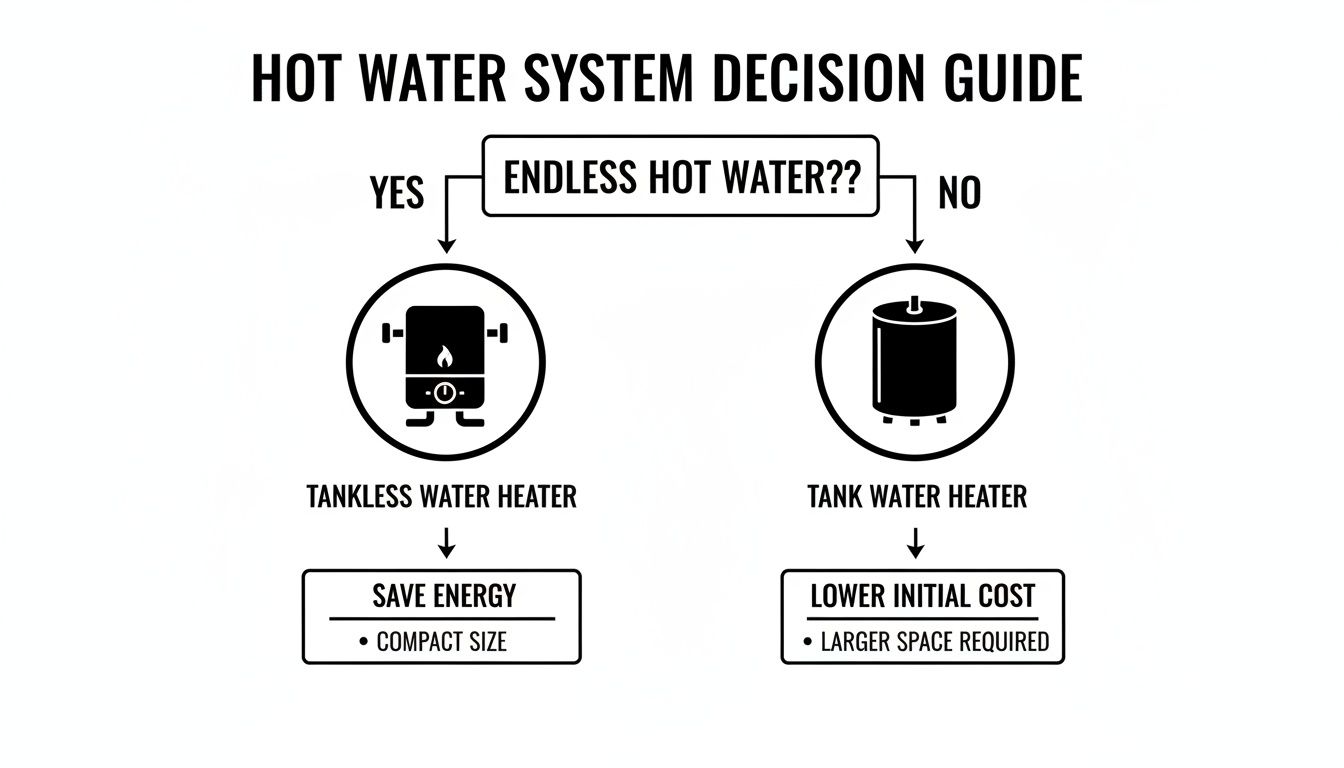
As you can see, if an endless supply of hot water is your top priority, the path points straight to a tankless system.
Recommendations For Your Situation
If you're a property manager in Walker or Standale, you'll want to prioritize the durability and low-maintenance nature of tankless systems. Their 20+ year lifespan translates to fewer replacement headaches and happier tenants. For builders putting up new homes in Wyoming, Michigan, leaning toward tankless models is a smart move to meet modern energy codes and offer a premium feature that new buyers love.
There's no single "best" answer that fits every situation. The right water heater is the one that aligns with your property's demands, your financial goals, and your family's need for comfort and reliability.
The surest way to make a confident decision is to get some expert advice. A professional can come out, look at your home's specific plumbing setup, understand your family's usage patterns, and work within your budget. Contact Platinum Heating & Cooling today for a personalized assessment to find the perfect water heating solution for your West Michigan home or business.
Frequently Asked Questions
Choosing between a tankless and a regular water heater always brings up a few last-minute questions. We get it. Here are some clear, no-nonsense answers to the most common things we hear from homeowners across West Michigan, helping you lock in your final decision with confidence.
Can A Tankless Water Heater Handle A Cold Michigan Winter?
Yes, absolutely. This is probably the biggest myth we have to bust for West Michigan homeowners. While our brutally cold groundwater in the winter does make the unit work harder, a professionally sized tankless model is built for this exact challenge.
An experienced installer doesn't just guess; we calculate the specific "temperature rise" needed—the difference between the frigid incoming water and your desired hot water temp. From November through April, this is critical. A properly sized unit ensures you have endless hot water for a steamy shower, even on the coldest mornings in Hudsonville or Allendale. It's all about getting the sizing right for our local climate.
Is A Regular Tank Heater Better For A Small Household On A Budget?
For a smaller household or anyone keeping a close eye on the initial budget, a traditional storage tank water heater is often the most practical starting point. There's no getting around it: the upfront purchase and installation cost is significantly lower than a tankless system. For many, that's the bottom line.
While you won't get the long-term energy savings of on-demand technology, a modern, well-insulated tank heater is still a reliable and efficient machine. For a one or two-person household in Grandville or Jenison with pretty standard hot water needs, that lower initial investment just makes more financial sense right now.
The choice really boils down to your priorities. If a low upfront cost is the main goal, a tank heater is a dependable workhorse. If you're playing the long game for energy savings and truly endless hot water, the investment in tankless technology pays for itself over time.
How Do I Know What Size Water Heater My Home Needs?
Sizing is absolutely crucial for both types of heaters, and it’s definitely not a one-size-fits-all situation. For a regular tank, we look at the First Hour Rating (FHR). This tells us exactly how many gallons of hot water the heater can deliver in an hour of peak use, starting with a full tank. It’s the best way to match the tank’s capacity to your family’s morning rush.
Sizing a tankless unit is a bit more involved. We have to figure out two key things:
- Required Flow Rate: We calculate the maximum gallons per minute (GPM) your household might use at once (think shower running, dishwasher on, and someone washing their hands).
- Necessary Temperature Rise: This is the big one for Michigan. We measure the difference between our cold groundwater and your target hot water temp (usually 120°F).
Getting this right for a home or business in Walker or Wyoming, Michigan requires a professional on-site assessment. It’s the only way to guarantee you get the performance you need without overpaying for a unit that’s way more powerful than you’ll ever use.
Ready to figure out the perfect water heater for your West Michigan home or business? The certified pros at Platinum Heating & Cooling are here to help. We provide expert consultations and flawless installations to make sure you enjoy reliable, efficient hot water for years to come. Schedule your free estimate today!