
Keeping your home comfortable year-round in West Michigan, from Hudsonville's humid summers to Wyoming's freezing winters, starts with a healthy HVAC system. But how do you know if your furnace or air conditioner is truly in top shape? A simple visual check is not enough. A detailed HVAC system inspection checklist is your best tool for ensuring efficiency, safety, and longevity, preventing you from being left in the cold during a Standale winter or sweating through an Allendale summer.
This guide breaks down the 10 most critical inspection points. We will clarify which tasks homeowners can safely handle and when it's essential to call certified professionals like the team at Platinum Heating & Cooling. We'll detail what our technicians look for during service calls in West Michigan, including Hudsonville, Jenison, Grandville, Walker, Standale, Allendale, & Wyoming michigan, providing you with actionable insights to prevent costly breakdowns and lower your energy bills. This isn't just about passing or failing; it's about understanding the health of your system.
Whether you're preparing for the cooling season (May through October) or gearing up for the critical heating demands of a northern winter (November through April), this checklist will empower you. You'll learn to spot early warning signs, understand the condition of key components like your heat exchanger and condenser coils, and know exactly when professional help is needed to maintain peak performance. Let's get started on the path to a more reliable and efficient home comfort system.
1. Thermostat Calibration and Functionality Testing
The thermostat is the command center of your entire HVAC system. It tells your furnace when to turn on during a cold Hudsonville winter and signals your air conditioner to start during a warm summer day. If it isn't reading the room temperature correctly or communicating properly, your entire system can suffer, leading to discomfort, wasted energy, and unnecessary wear and tear. This essential step in our HVAC system inspection checklist verifies that this critical component is functioning with precision.
A proper test involves much more than just looking at the display. It’s a detailed verification process to ensure accuracy and responsiveness.
What We Check and Why It Matters
Our technicians perform a multi-point inspection of your thermostat's performance:
- Temperature Accuracy: We use a calibrated, professional-grade thermometer to check the ambient room temperature and compare it to the thermostat’s reading. A common issue we find in homes across Jenison and Grandville is a thermostat reading two or three degrees off, causing the system to run too often or not enough.
- Cycle Testing: We manually trigger both the heating and cooling cycles, regardless of the season. This confirms the thermostat correctly sends signals to the furnace and AC unit and that the equipment responds promptly.
- Programmable and Smart Features: For modern thermostats, we verify that programmed schedules are running correctly, Wi-Fi connections are stable, and any smart home integrations are communicating without errors. A failed wireless connection in a smart thermostat can revert settings to a default mode, erasing your energy-saving programs.
- Location Assessment: The thermostat's placement can drastically affect its readings. We check if it's located away from direct sunlight, drafts, or heat sources like lamps or kitchen appliances, which can cause false readings.
Technician Insight: "We often see homeowners in Allendale and Wyoming, MI, dealing with high energy bills, and the culprit is a simple thermostat calibration error. A unit that's just 3°F off can increase heating and cooling costs by nearly 10% over a year."
Proper thermostat function is the first step to an efficient and reliable HVAC system. By confirming its accuracy and responsiveness, we ensure your home or business in West Michigan remains comfortable while keeping your energy consumption in check. If we find your thermostat is nearing the end of its 15-year lifespan or is malfunctioning, we can recommend and install a modern replacement that fits your needs. As a Platinum Heating & Cooling maintenance member, you also get the benefit of thermostat programming optimization during every tune-up.
2. Air Filter Condition and MERV Rating Verification
The air filter is the unsung hero of your HVAC system, acting as its first line of defense. It captures dust, pollen, pet dander, and other airborne particles, protecting both your system's sensitive components and your home's indoor air quality. A clogged or incorrect filter can starve your system of essential airflow, causing it to work harder, run less efficiently, and eventually break down. This step in our HVAC system inspection checklist ensures this simple but vital part is doing its job correctly.
A thorough filter inspection is more than just a quick glance; it's a critical assessment of cleanliness, fit, and suitability for your specific HVAC equipment.
What We Check and Why It Matters
Our technicians conduct a detailed evaluation of your air filter's status:
- Cleanliness and Condition: We visually inspect the filter for dirt and debris buildup. In homes across Walker and Standale, we often find filters that haven't been changed for over six months, leading to restricted airflow that can cause the furnace to short-cycle or the AC coils to freeze.
- Size and Fit: An improperly sized filter allows air to bypass it, sending dust and contaminants directly into your HVAC system. We confirm the filter is the correct size and seated properly in its housing to create a tight seal.
- MERV Rating Verification: We check the filter's Minimum Efficiency Reporting Value (MERV) rating. While a higher MERV rating captures smaller particles, it also increases airflow resistance. Installing a MERV 16 filter in a system designed for a MERV 8 can strain the blower motor, increasing energy use and potentially causing damage. We ensure the filter's MERV rating is optimal for your system's design.
- Frequency and Household Factors: We assess your home environment (pets, allergies, nearby construction) to recommend a realistic filter change schedule, typically every 1-3 months. For our maintenance plan members, filter replacement is part of every scheduled visit.
Technician Insight: "We serviced a multi-unit building in Grandville where several tenants complained about poor heating during the winter months. The issue wasn't the furnaces; it was critically clogged filters in each unit. Once we replaced them, the airflow was restored, and the problem was solved. It's a simple fix that prevents major repairs."
A clean, properly-rated filter is fundamental to an efficient HVAC system and healthy indoor air. This simple check can significantly reduce your heating costs during a harsh West Michigan winter (November through April) and improve cooling performance in the summer months (May through October). If we find an issue, we can provide and install the correct filter, keeping your system running smoothly and your air clean.
3. Refrigerant Level and Charge Testing
The refrigerant in your air conditioner is its lifeblood, responsible for absorbing heat from inside your home and releasing it outside. Contrary to common belief, refrigerant is not a fuel; it doesn't get "used up" like gasoline in a car. If your system is low on refrigerant, it means there is a leak. An incorrect refrigerant level, whether too low or too high, forces the system to work harder, reduces cooling capacity, and can lead to catastrophic compressor failure, one of the most expensive HVAC repairs. This part of our HVAC system inspection checklist is a technical and crucial step to protect your investment during the cooling months of May through October.
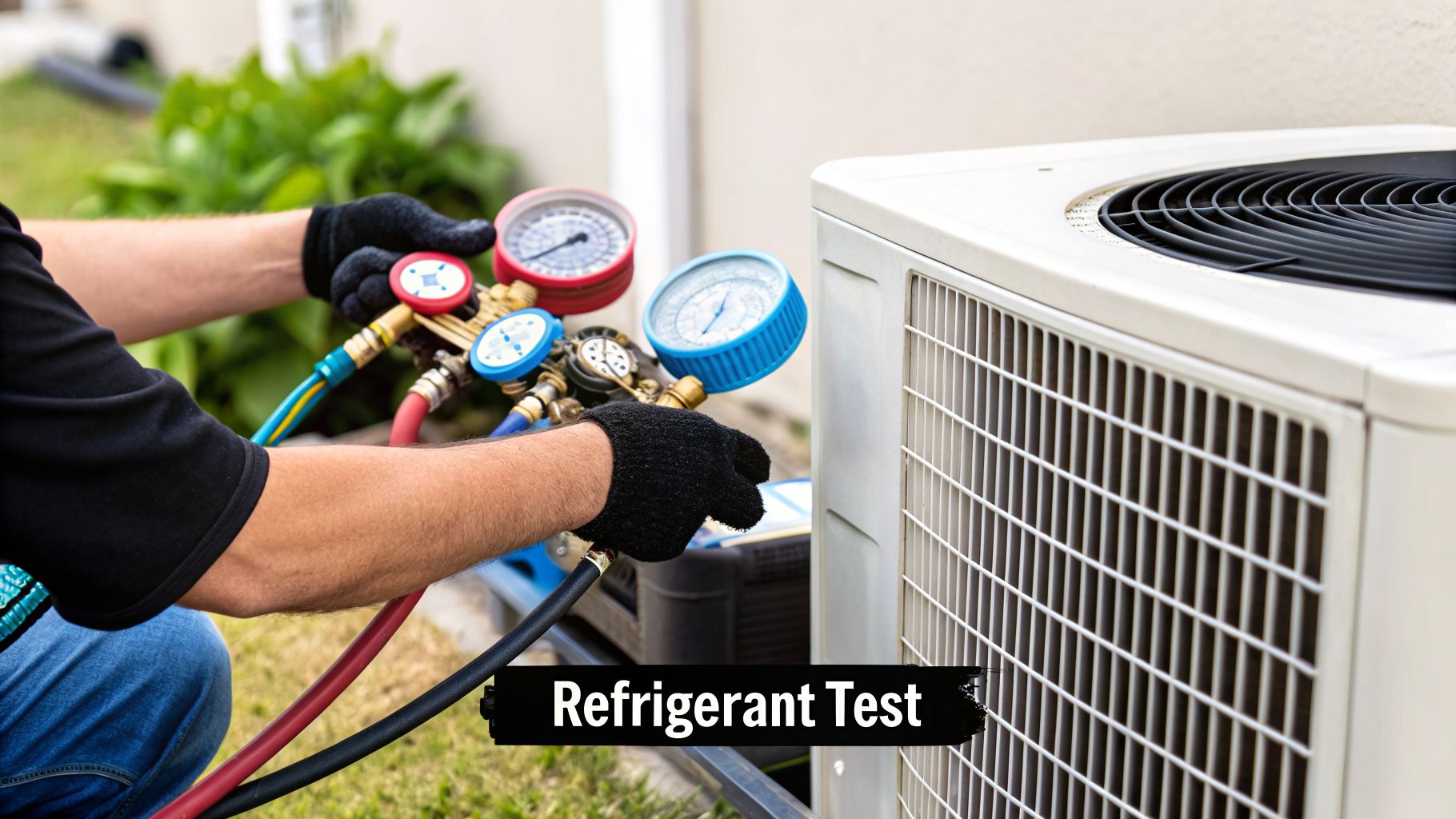
A professional refrigerant service involves precise measurements using specialized tools and requires EPA Section 608 certification to handle these chemicals safely and legally.
What We Check and Why It Matters
Our NATE-certified technicians perform a detailed analysis of your system's refrigerant charge:
- Pressure and Temperature Readings: We connect a manifold gauge set to your system’s service ports to measure operating pressures. We also take critical temperature readings at key points to calculate superheat (for fixed orifice systems) or subcooling (for TXV systems). These calculations are the only way to know for certain if the charge is correct for the current conditions.
- Leak Detection: If we find a low charge, we don’t just "top it off." That’s a temporary fix for a permanent problem. We perform a thorough electronic leak detection to find the source of the refrigerant loss, which could be a tiny pinhole in a coil or a loose fitting. Finding and fixing the leak is essential for long-term reliability.
- Charge Verification: We see systems in Walker and Standale that have been overcharged by previous, less-qualified technicians. An overcharged system is just as damaging as an undercharged one, causing high pressure that can shut the system down or damage the compressor. We verify the charge against the manufacturer’s specifications.
- Documentation: We document the baseline pressure and temperature readings in your system’s service record. This creates a valuable performance history that helps us spot slow leaks or developing problems on future visits.
Technician Insight: "A system that's just 10% low on refrigerant can lose over 20% of its efficiency and cost you a lot more on your summer electric bills. We recently prevented a costly compressor replacement for a client in Jenison by catching a slow leak during a spring tune-up."
Ensuring your system has the correct refrigerant charge is vital before the peak summer heat arrives in West Michigan. As a Platinum Heating & Cooling maintenance member, this detailed check and any necessary adjustments (up to 1lb of refrigerant) are included, giving you peace of mind that your AC is ready to perform efficiently and reliably all summer long.
4. Blower Motor and Fan Performance Assessment
The blower motor is the powerful heart of your HVAC system's air delivery network. Whether pushing warm air through your ducts on a cold Wyoming winter night (from November through April) or circulating cool, conditioned air during a hot summer afternoon (from May through October), this component is responsible for the airflow that keeps your home comfortable. A struggling or failing blower motor will reduce efficiency, diminish comfort, and eventually lead to a complete system breakdown, making its evaluation a vital part of any HVAC system inspection checklist.
A thorough assessment goes beyond just seeing if the fan spins. It involves a detailed check of its mechanical and electrical health to ensure it can deliver the right amount of air quietly and efficiently.
What We Check and Why It Matters
Our technicians perform a comprehensive inspection of the blower assembly's condition and operation:
- Audible and Vibrational Analysis: We listen for squealing, grinding, or humming noises that indicate worn bearings or other internal motor issues. Excessive vibration can point to an unbalanced fan blade or failing motor mounts, which can cause damage to other components.
- Capacitor Testing: The run capacitor provides the necessary electrical jolt to start and run the motor. We test its microfarad (μF) reading to ensure it's within the manufacturer's specified range. A weak capacitor can cause slow startups, motor overheating, and eventual failure.
- Airflow Measurement: Using specialized tools, we measure the volume of air moving through the ducts. Low airflow is a common complaint in Walker and Standale homes, often stemming from a dirty blower wheel or a motor that's struggling to reach its proper speed.
- Visual Inspection and Cleaning: We inspect the blower wheel (or "squirrel cage") for dirt and debris buildup. A caked-on layer of dust can unbalance the fan, restrict airflow, and put immense strain on the motor.
Technician Insight: "I recently worked on a system in a Grandville office building where employees complained about stuffy air. The blower motor sounded like it was struggling. A quick test revealed a failed capacitor, which we replaced on the spot. The improved airflow was immediately noticeable, and we prevented an expensive emergency motor replacement."
Ensuring your blower motor and fan operate correctly is fundamental to both comfort and system longevity. By identifying early signs of wear, we can perform preventative repairs, keeping your home in Allendale or Jenison comfortable year-round and helping you avoid the higher costs and inconvenience of an unexpected breakdown. If your motor is over 12 years old, we may recommend a planned replacement to ensure future reliability.
5. Heat Exchanger Inspection and Crack Detection
Deep inside your furnace, the heat exchanger is arguably the most critical component for both warmth and safety. This metal chamber separates the air you breathe from the toxic combustion gases produced by burning fuel. A crack, hole, or significant corrosion can allow deadly, odorless carbon monoxide (CO) to mix with your home's air supply. This makes a thorough heat exchanger check a non-negotiable part of any professional HVAC system inspection checklist, especially during the harsh winter months in West Michigan (November through April).
A proper inspection goes far beyond a quick visual glance. It requires specialized tools and a systematic process to ensure no defects are missed, protecting your family or tenants from a silent threat.
What We Check and Why It Matters
Our technicians conduct a detailed evaluation of the heat exchanger to confirm its structural integrity:
- Visual and Camera Inspection: We begin with a visual check for obvious signs of stress, such as rust, corrosion, or discoloration. For furnaces over 15 years old, or when any signs of wear are present, we use a specialized endoscopic camera to view the interior surfaces where tiny, hard-to-see cracks often form.
- Combustion Gas Analysis: A visual inspection alone is not enough. We use a professional-grade combustion analyzer to measure the chemical composition of the flue gases. Abnormal readings can indicate incomplete combustion or a breach in the heat exchanger, even before a crack is visible.
- Carbon Monoxide Testing: We test the air in the supply plenum while the furnace is running to detect any presence of carbon monoxide. Finding any CO in the airstream is an immediate red flag that points to a dangerous breach. We recently found a 10-year-old furnace in a Walker home with a micro-crack that was leaking low levels of CO, preventing a potential tragedy.
- Flame Pattern Observation: The color and behavior of the burner flames can reveal a lot. A dancing, yellow, or wavering flame, instead of a steady blue one, can be a sign of a cracked heat exchanger pulling air from the blower compartment into the combustion chamber.
Technician Insight: "In a multi-unit building in Grandville during a winter service call, we discovered dangerous CO levels of 150 ppm in a basement utility room, traced back to a severely corroded heat exchanger. Because a crack in the heat exchanger is not repairable, the furnace must be shut down and replaced immediately. Don’t rely solely on your CO detector; a professional inspection is your first line of defense."
A compromised heat exchanger is a serious safety hazard that requires immediate action. By performing a multi-faceted inspection, our team ensures your furnace operates not just efficiently, but safely. If we detect a defect, we will shut down the unit, show you the evidence, and provide clear options for furnace replacement to restore safety and comfort to your home or business.
6. Ductwork Integrity and Seal Assessment
Your ductwork is the circulatory system of your home's HVAC, responsible for delivering conditioned air to every room. If this network has leaks, disconnections, or poor insulation, a significant portion of the heated or cooled air you pay for never reaches its destination. This forces your furnace and air conditioner to work harder, driving up energy bills and causing uneven temperatures. A thorough ductwork assessment is a vital part of any HVAC system inspection checklist, ensuring efficient and effective air distribution.
Inspecting your ducts goes far beyond a quick glance. It involves a detailed visual and sometimes technical examination of the entire accessible network to pinpoint energy loss, air quality issues, and safety hazards.
What We Check and Why It Matters
Our technicians conduct a systematic inspection of your home's duct system, a common source of hidden problems in West Michigan homes, including Hudsonville, Jenison, Grandville, and Allendale.
- Visual Inspection for Leaks and Damage: We meticulously examine all visible duct runs in attics, basements, and crawl spaces. We look for disconnected joints, crushed sections, holes, and failing seals. In one Walker home, we found an 8-foot section of flex duct completely disconnected in the attic, resulting in a nearly 20% loss in efficiency and a master bedroom that was impossible to cool.
- Sealant and Tape Condition: Standard duct tape is not a permanent solution and often fails over time. We check for cracked or peeling tape and recommend sealing accessible joints with durable mastic sealant, which creates a long-lasting, airtight bond.
- Insulation Integrity: In older homes around Standale and Jenison, duct insulation can deteriorate, compress, or be missing entirely. Uninsulated ducts running through an unconditioned attic or crawlspace can lose a massive amount of thermal energy, forcing your system to run longer to heat your home during our cold winters (November through April).
- Airflow and Boot Connections: We ensure that the supply boots, where the ducts connect to your room vents, are properly attached and sealed. A disconnected boot can pump conditioned air directly into your walls or ceilings instead of the room.
Technician Insight: "Leaky ducts can account for up to 30% of a home's heating and cooling energy loss. We often find that homeowners in Allendale are paying to heat their attic in the winter and cool their crawlspace in the summer without even realizing it. Sealing those leaks provides an immediate and noticeable improvement in comfort and efficiency."
A sealed and insulated duct system ensures that conditioned air gets where it's needed efficiently. By identifying and correcting these issues, we can significantly lower your energy bills, improve indoor air quality by preventing dust and allergens from being pulled into the system, and create more consistent temperatures throughout your property. Our Platinum Heating & Cooling maintenance plan includes a detailed ductwork inspection to catch these costly problems early.
7. Combustion Safety and Gas Connection Verification
For homes with natural gas furnaces, safe operation is the most critical aspect of any HVAC service. A gas furnace generates heat through controlled combustion, and ensuring this process is safe, contained, and efficient is a non-negotiable part of our HVAC system inspection checklist. This step involves a meticulous inspection of the entire gas and exhaust system, from the supply line to the point where combustion byproducts safely exit your home. It’s a specialized check that protects your family from the serious risks of gas leaks and carbon monoxide exposure.
This verification goes far beyond a simple visual check. It requires specialized tools and deep knowledge of gas appliance codes to confirm every component is working as intended, especially before firing up the heat for a cold Walker, MI winter (from November through April).
What We Check and Why It Matters
Our technicians use advanced equipment and follow strict protocols to ensure your furnace's combustion system is secure:
- Gas Leak Detection: We use an electronic gas leak detector to inspect the entire gas line, from the shutoff valve to the gas valve inside the furnace. This sensitive tool can detect minute leaks that are odorless and undetectable by human senses, preventing a dangerous accumulation of gas.
- Burner Operation and Ignition: We observe the furnace ignition sequence, checking for a smooth, immediate light-off. A delayed ignition or a roaring sound can indicate dirty burners or a failing ignitor, which could create a minor gas buildup before ignition, a significant safety concern.
- Combustion Analysis: Using a calibrated combustion analyzer, we measure the chemical composition of the exhaust flue gases. This test confirms the fuel-to-air ratio is correct, ensuring complete combustion and minimal carbon monoxide production. It also directly measures the system's efficiency.
- Venting and Draft Verification: We check that the furnace flue pipe has a proper "draft," meaning the exhaust gases are being pulled up and out of the home effectively. An improper draft can cause exhaust, including deadly carbon monoxide, to spill back into your living space.
Technician Insight: "During a routine tune-up in Standale, our electronic detector picked up a slow gas leak at the furnace's union fitting. The homeowner had no idea. Finding that small issue before it became a major hazard is exactly why this safety check is the most important thing we do."
Ensuring combustion safety is paramount for any home in West Michigan that relies on natural gas for heat. This detailed inspection provides peace of mind, knowing your system is not only running efficiently but, most importantly, safely. As part of our Platinum Heating & Cooling maintenance plan, we document these safety and combustion readings every year to monitor your system’s health and ensure your family’s well-being.
8. Electrical Components and Control System Testing
The electrical system is the nervous system of your HVAC equipment. It carries the signals from the thermostat and powers the fans, motors, and compressors that deliver comfort to your home. Damaged or faulty electrical components are not just a reliability issue; they are a serious safety hazard that can lead to system failure or even fire. This vital part of any professional HVAC system inspection checklist ensures all electrical pathways are safe, secure, and functioning correctly.
A comprehensive electrical inspection goes beyond a simple visual check. It involves testing individual components and connections to prevent unexpected breakdowns and ensure your system operates as designed.
What We Check and Why It Matters
Our NATE-certified technicians perform a detailed examination of your system's electrical integrity:
- Capacitor and Contactor Testing: Capacitors provide the initial jolt of electricity needed to start your AC's compressor and fans. A weak or failing capacitor is a common cause of a system that hums but won't start. We test capacitor strength and inspect contactors for pitting or burning that can cause intermittent operation on a hot Grandville day.
- Wiring and Connection Security: Vibrations from normal operation can cause electrical connections to loosen over time. We meticulously inspect and tighten all terminals in the furnace and air conditioner, looking for frayed wires or corrosion that could lead to a short circuit or complete system failure.
- Voltage and Amperage Readings: We measure the voltage and amperage draw on critical components like motors. Readings outside the manufacturer's specifications can indicate a part is straining and close to failure, allowing us to address it proactively.
- Safety Control Verification: Your system has multiple safety switches, such as high-limit switches and drain overflow sensors. We test these controls to confirm they will shut the system down correctly in an unsafe condition, protecting your equipment and your home in Walker or Standale.
Technician Insight: "For property managers in the Grandville and Wyoming area, intermittent electrical faults are a nightmare. We found a multi-unit building where a single loose wire was causing sporadic AC outages during the summer months. Tightening connections and documenting baseline voltages during our maintenance visit solved the problem and prevented multiple tenant complaints."
Ensuring the electrical health of your HVAC system is critical for both performance and safety. A single faulty component can cascade into a much more expensive repair, like a burnt-out compressor. If we identify worn-out parts like capacitors or relays, we can replace them on the spot, restoring reliability and giving you peace of mind. As a Platinum Heating & Cooling maintenance member, you receive this detailed electrical inspection with every tune-up.
9. Condenser and Evaporator Coil Cleanliness
Your HVAC system's coils are where the magic of heat exchange happens. The outdoor condenser coil releases heat extracted from your home, while the indoor evaporator coil absorbs heat to cool the air. When these coils are coated in dirt, pollen, and debris, their ability to transfer heat is severely hampered. This forces your system to work much harder, reducing efficiency, diminishing cooling capacity, and increasing your energy bills during hot West Michigan summers (May through October).
A critical part of any HVAC system inspection checklist is ensuring these coils are clean and free of obstructions. Neglecting them is like forcing a marathon runner to breathe through a straw-it simply can't perform at its peak.
What We Check and Why It Matters
Our technicians conduct a detailed inspection and, if necessary, a professional cleaning of both the condenser and evaporator coils.
- Condenser Coil Inspection: The outdoor unit is constantly exposed to the elements. We meticulously check the condenser coil's fins for buildup of cottonwood fluff, grass clippings, dust, and pollen, which are common problems in areas like Walker and Standale. A completely blocked coil can cause the system to overheat and shut down on the hottest days.
- Evaporator Coil Inspection: The indoor evaporator coil lives in a dark, damp environment, making it a prime spot for mold, mildew, and bacteria to grow. We inspect the coil and its drain pan for any biological growth or blockages, which can cause musty odors and restrict airflow, leading to poor cooling and potential water damage.
- Fin Condition: We check for bent or damaged fins on both coils. Even a small area of bent fins can disrupt airflow and reduce efficiency. We use a special fin comb to gently straighten them, restoring proper system function.
- Cleaning Method Assessment: Aggressively pressure washing a coil can easily damage the delicate aluminum fins, leading to expensive repairs. We determine the correct, safe cleaning method, using professional-grade coil cleaners and low-pressure water to protect your investment. You can find more details in our guide on how to clean an AC condenser unit.
Technician Insight: "We had a customer in Jenison whose AC was running constantly but barely cooling. We found the outdoor condenser coil was so packed with cottonwood fluff it looked like a wool blanket. After a professional cleaning, the system's cooling capacity improved by over 20%, and their next energy bill dropped significantly."
Regular coil cleaning, especially in the spring before the cooling season begins, is vital for maintaining your system's health and efficiency. For Platinum Heating & Cooling maintenance members, this essential service is a key part of our annual tune-up, ensuring your AC is ready to handle whatever summer brings.
10. System Age, Performance Testing and Remaining Lifespan Estimation
Every HVAC system has a finite lifespan, and knowing where your equipment stands is crucial for budgeting and preventing unexpected failures. An older furnace struggling through a frigid Wyoming winter (from November through April) or an aging air conditioner in the summer heat of Standale (from May through October) poses a risk of breakdown when you need it most. This part of our HVAC system inspection checklist involves a deep dive into your system's history, current performance, and overall health to forecast its remaining useful life.
This evaluation provides a clear, data-driven picture of your system's condition, moving beyond simple guesswork to give you a strategic plan for future repairs or replacement.
What We Check and Why It Matters
Our technicians conduct a comprehensive analysis to estimate your system's longevity and performance:
- Age and Repair History Verification: We start by documenting the unit's serial number to determine its exact manufacturing date. We then review its repair history, as a 15-year-old furnace with multiple recent repairs in Jenison is a much higher replacement priority than a well-maintained unit of the same age.
- Performance Benchmarking: We measure key performance indicators, like temperature drop across the evaporator coil for an AC or temperature rise for a furnace. We compare these real-world numbers to the manufacturer's original specifications. A furnace rated for 80,000 BTUs that is only delivering 65,000 BTUs indicates a significant performance decline.
- Refrigerant Type Assessment: For air conditioners, identifying the refrigerant type is critical. If your unit still uses R-22, which is now phased out, any future repairs requiring a refrigerant charge will be extremely expensive and difficult. We often recommend a planned upgrade to a modern, efficient R-410A system in these cases.
- Component Wear and Tear: We visually inspect critical components for signs of advanced corrosion, rust, and wear. This physical evidence, combined with performance data, helps build a complete picture of the system's health.
Technician Insight: "For property managers in Grandville and Walker, we create a phased replacement schedule based on this analysis. It allows them to budget for new units over several years, avoiding the financial shock of multiple simultaneous system failures. It turns a reactive crisis into a proactive, manageable plan."
Understanding your system's remaining lifespan helps you plan for one of your home’s largest investments. The benefits of HVAC maintenance are most apparent here, as regular tune-ups provide an annual "health score" for your system, tracking its performance over time. When replacement becomes the most economical option, we can discuss financing, rebates, and incentives for a new high-efficiency system to keep your West Michigan home comfortable for years to come.
10-Point HVAC Inspection Comparison
| Item | Implementation complexity | Resource requirements | Expected outcomes | Ideal use cases | Key advantages |
|---|---|---|---|---|---|
| Thermostat Calibration and Functionality Testing | Low–Moderate (simple checks to smart integrations) | Infrared thermometer, access to multiple rooms, battery/network tools | Accurate temperature readings, verified cycles/schedules | Comfort complaints, new smart thermostat installs, routine tune-ups | Reduces energy waste; prevents short-cycling; improves comfort |
| Air Filter Condition and MERV Rating Verification | Low | Visual inspection tools, replacement filters, MERV reference | Restored airflow, improved indoor air quality, filter schedule | High-dust/pet homes, routine maintenance, IAQ concerns | Simple, low-cost fix; extends equipment life; improves IAQ |
| Refrigerant Level and Charge Testing | High (requires certification) | EPA-certified tech, manifold gauges, leak detector, pressure tools | Correct refrigerant charge, leak identification, optimal efficiency | Reduced cooling capacity, suspected leaks, pre-season checks | Prevents compressor damage; ensures efficiency; regulatory compliance |
| Blower Motor and Fan Performance Assessment | Moderate | Airflow meter/anemometer, vibration/noise detection tools, capacitor tester | Reliable airflow, early motor/fan fault detection, balanced operation | Noisy systems, uneven airflow, aging motors | Prevents sudden failures; improves airflow consistency; prolongs components |
| Heat Exchanger Inspection and Crack Detection | Moderate–High | Flashlight/mirror, CO detector, combustion analyzer, internal camera if needed | Detection of cracks/CO risks, safety verification, replacement recommendations | Older furnaces, CO concerns, safety inspections | Prevents CO exposure; meets safety codes; reduces liability |
| Ductwork Integrity and Seal Assessment | Moderate | Attic/crawl access, smoke or pressure tester, sealing materials (mastic) | Reduced leakage, improved distribution, energy savings | High energy bills, uneven temps, post-install audits | High ROI sealing; improves comfort; reduces equipment strain |
| Combustion Safety and Gas Connection Verification | High | Electronic gas detector, combustion analyzer, trained technician | Verified gas seals/pressures, correct combustion, safe venting | Gas furnaces, post-service safety checks, pre-season inspections | Prevents gas/CO hazards; code-compliant; essential liability protection |
| Electrical Components and Control System Testing | Moderate–High | Multimeter, clamp meter, insulation tester, technician electrical skills | Electrical safety, reliable starts, detection of failing components | Intermittent operation, failed starts, preventive maintenance | Prevents fires/shock; early fault detection; inexpensive preventative fixes |
| Condenser and Evaporator Coil Cleanliness | Low–Moderate | Soft brushes, low-pressure spray, EPA-approved cleaning solutions, access to units | Restored heat transfer, improved cooling capacity, fewer freeze/overheat events | Seasonal maintenance, reduced capacity, dirty outdoor units | Low-cost, high-impact efficiency gains; extends component life |
| System Age, Performance Testing and Remaining Lifespan Estimation | High | Data loggers, anemometer, combustion analyzer, refrigerant gauges, serial research | Estimated remaining life, performance benchmarks, replacement timing | Older systems, pre-sale evaluations, long-term planning | Informs replacement decisions; justifies investments; builds customer trust |
Partner with the Pros for Year-Round Peace of Mind
Navigating the extensive hvac system inspection checklist we've outlined reveals a clear truth: a truly healthy heating and cooling system relies on a partnership between diligent homeowners and certified professionals. Your efforts in performing monthly checks, like swapping out air filters and keeping outdoor units clear of debris, form the first line of defense against inefficiency and premature failure. These simple actions are foundational to maintaining good airflow and reducing strain on your equipment.
However, the checklist also illuminates the critical, and often hazardous, tasks that demand specialized knowledge. Items like refrigerant level testing, heat exchanger crack detection, and combustion safety analysis are not just complex; they are essential for the safety and longevity of your system. Attempting these inspections without proper training and tools can lead to dangerous gas leaks, electrical hazards, or catastrophic equipment damage. This is where the line between DIY maintenance and professional service becomes non-negotiable.
From Checklist to Confident Comfort
The true value of this inspection guide isn't just in ticking off boxes; it's about understanding the "why" behind each step.
- Safety First: A cracked heat exchanger or a faulty gas connection isn't just an efficiency issue, it's a serious safety risk. Professional inspections are your best defense against carbon monoxide exposure.
- Efficiency and Savings: Clean coils, properly charged refrigerant, and sealed ductwork directly translate to lower energy bills. A technician can identify and correct the subtle inefficiencies that quietly inflate your monthly costs.
- Longevity and Prevention: Regular professional tune-ups catch small problems before they become major breakdowns. Replacing a worn capacitor is far cheaper and less disruptive than a full system replacement in the middle of a West Michigan winter.
For residents and business owners in West Michigan, including Hudsonville, Jenison, Grandville, Walker, Standale, Allendale, & Wyoming michigan, this proactive approach is key. You don't want to discover your furnace has a critical flaw during a January cold snap or find your air conditioner is failing on the first humid day of summer. Consistent, professional maintenance transforms your HVAC system from a potential liability into a reliable asset that delivers consistent comfort.
Key Takeaway: The relationship between DIY checks and professional inspections is symbiotic. Your monthly diligence makes our professional tune-ups more effective, and our expert service ensures your system is safe, efficient, and ready for whatever the season brings.
Ultimately, this hvac system inspection checklist serves as your roadmap to total home comfort and system reliability. By understanding which tasks are yours and which require a seasoned expert, you empower yourself to make smart decisions for your home, your budget, and your family's well-being. Don’t just wait for a problem to announce itself; take control by scheduling the professional oversight your system needs to perform at its best, year after year.
Ready to ensure your system is running safely and efficiently? The certified technicians at Platinum Heating & Cooling are experts in performing every check on this list and more for homes and businesses throughout West Michigan, including Hudsonville, Jenison, Grandville, Walker, Standale, Allendale, & Wyoming michigan. Schedule your comprehensive inspection today or ask about our Platinum Maintenance Membership to protect your investment for years to come.